
On why game engines became the operating systems of the virtual world, the specific skills that separate game developers from software engineers in the context of spatial computing, the economics of user-generated content at scale, the convergence of gaming and enterprise in the industrial metaverse, and why the people who know how to build interactive real-time environments are among the most consequential technologists of the current era
The technology that will define the next phase of computing was not built in research laboratories or enterprise software companies. It was built in game studios. The physics engine that simulates how objects fall, collide, and deform under force — built for games. The rendering pipeline that generates photorealistic environments in real time at sixty frames per second — built for games. The networked architecture that allows millions of users to exist simultaneously in a shared virtual space — built for games. The tools for building, populating, and monetising interactive three-dimensional worlds — built, overwhelmingly, for games. When the broader technology industry decided it wanted to build the metaverse, it discovered that the game industry had been building its components for thirty years.
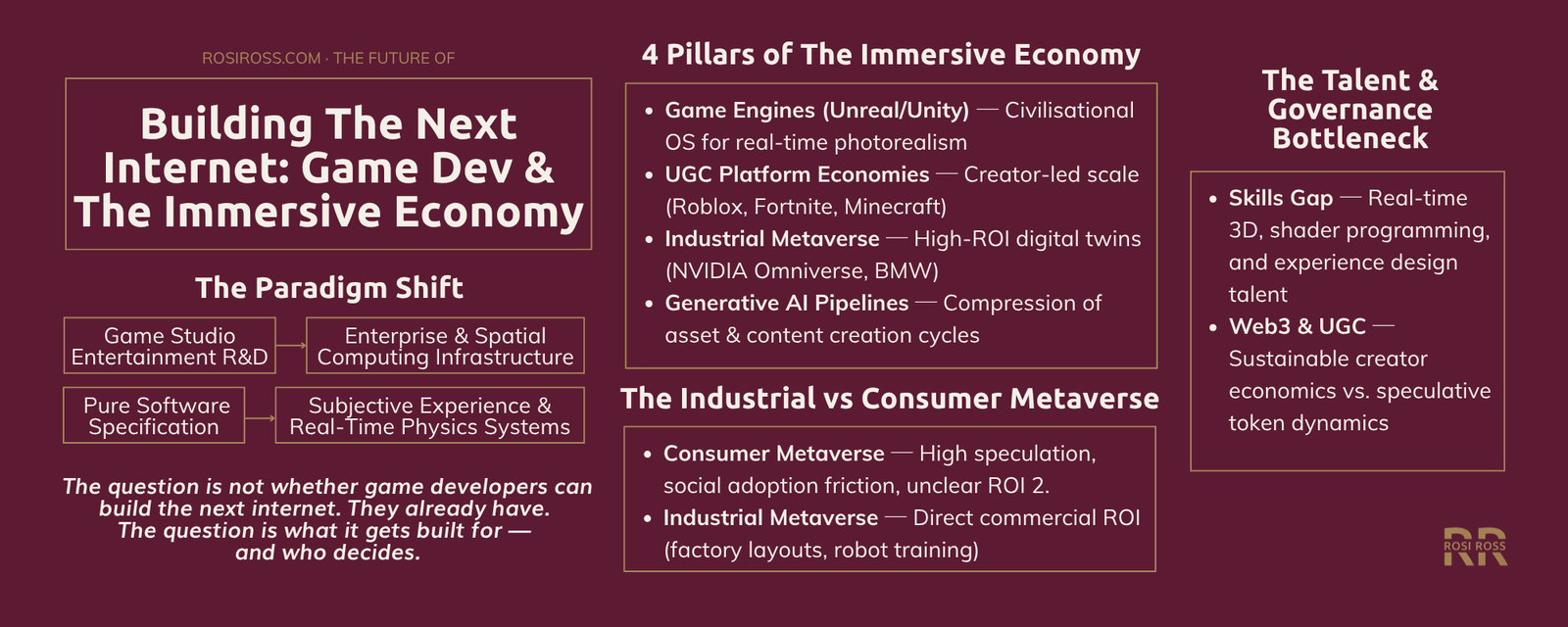
This is the most underappreciated fact about the current state of virtual world development: the technical foundations of the immersive internet already exist, and the people who know how to build with them are game developers. The question is not whether the infrastructure for persistent, interactive, socially inhabited virtual environments can be built. It can. The question is what it gets built for, who builds it, who governs it, and what economic model sustains it. Those are not technical questions. They are questions about power, economics, and the specific kind of human activity that virtual environments are capable of supporting — and they are the questions that the most serious people in game development, virtual world design, and spatial computing are working to answer.
The game engine as civilisational infrastructure
The game engine — the software framework that manages rendering, physics, audio, input, networking, and asset management in a real-time interactive application — is one of the most consequential pieces of software infrastructure ever built, and it is consistently underestimated in discourse about the future of computing because it emerged from an entertainment context rather than an enterprise or scientific one. Unreal Engine, developed by Epic Games and first released in 1998, and Unity, released in 2005, are the two dominant general-purpose game engines in current use. Between them, they provide the foundational technology for the majority of contemporary commercial game development and for an expanding range of non-game applications that require the same capabilities: real-time rendering, physics simulation, interactive object manipulation, and networked multi-user environments.
As Wired’s analysis of Unreal Engine’s expanding role documents, the non-game applications of game engine technology have grown from curiosity to core infrastructure in less than a decade. Automotive manufacturers use Unreal Engine for real-time configurator experiences and virtual showrooms. Architectural firms use it for interactive building visualisation. Film and television productions use it for virtual production — the technique, pioneered at scale on The Mandalorian, of replacing physical location shooting with LED volume stages displaying real-time rendered environments, allowing camera movement and lighting interaction with virtual backgrounds in ways that conventional green screen cannot provide. Industrial manufacturers use game engine technology for digital twin simulations — virtual replicas of physical factories, infrastructure, or product systems that allow testing, training, and optimisation without the cost or risk of physical intervention. Unreal Engine’s virtual production documentation identifies this convergence as one of the most significant structural shifts in the relationship between game technology and the broader creative and industrial economy.
The reason game engines became the operating system of the virtual world is specific: they are the only mature software frameworks that solve the problem of real-time interactive rendering at human-perceptible quality. A traditional software application does not need to generate a photorealistic three-dimensional environment at sixty frames per second while simultaneously simulating the physics of hundreds of interacting objects, processing network input from thousands of simultaneous users, and maintaining a consistent state across all of them. Games do. The technical solutions to these problems — developed under the commercial pressure of a $200 billion industry that requires them at increasing scale and fidelity — are precisely the solutions that every other application requiring real-time interactive three-dimensional environments needs. The same pattern that allowed AI tools developed in creative industries to reshape every sector that requires content generation is operating in game technology: the commercial intensity of the entertainment use case drove the technical development that the enterprise and industrial use cases are now adopting.
What is a Game Engine — and why has it become foundational technology for virtual worlds beyond gaming?A game engine is a software framework that provides the core systems required to build real-time interactive three-dimensional applications: a rendering engine (generating visual output from 3D scene data), a physics engine (simulating the behaviour of objects under force, gravity, and collision), an audio engine, an input system (processing user actions from controllers, keyboards, or other devices), a networking system (managing state synchronisation across multiple users), and an asset management system (loading, organising, and streaming visual, audio, and data assets efficiently). The two dominant general-purpose game engines are Unreal Engine (Epic Games, first released 1998) and Unity (released 2005). They became foundational technology for virtual worlds beyond gaming because they are the only mature software frameworks that solve the specific technical problem of real-time interactive rendering at human-perceptible quality — a problem that games required to be solved at commercial scale decades before other industries recognised that they needed the same capability. Film virtual production, automotive configurators, architectural visualisation, industrial digital twins, and spatial computing interfaces all deploy game engine technology for this reason.
What is Virtual Production in film and television — and why does it depend on game engine technology?Virtual production is a filmmaking technique that replaces conventional green screen backgrounds with large-scale LED volume stages displaying real-time rendered environments — allowing camera movement, lighting interaction, and compositional decisions to be made on set rather than in post-production. The technique, deployed at commercial scale on Disney’s The Mandalorian from 2019 onward, depends on game engine technology — specifically Unreal Engine — because only a game engine is capable of rendering photoreal three-dimensional environments in real time at sufficient resolution and frame rate to display convincingly on a large LED stage under production lighting conditions. The camera tracking system that adjusts the rendered perspective in response to camera movement in real time is the same system that adjusts a game’s virtual camera in response to player movement. Virtual production has expanded rapidly because it reduces location shooting costs, eliminates weather and logistical risk, and allows creative decisions about environment and lighting to be made during principal photography rather than months later in post-production — fundamentally changing the economics and creative process of high-budget film and television production.







What game developers actually know — and why it is different from software engineering
The conflation of game development with software engineering — the assumption that a skilled software engineer can build a game with the addition of some domain-specific knowledge — is one of the most persistent misconceptions about the discipline, and it has produced a specific and consequential failure mode in many technology companies that have attempted to enter the virtual world and gaming spaces. Software engineering, in the conventional sense, is concerned with the correct implementation of specified requirements: writing code that reliably performs defined functions within acceptable performance parameters. Game development is concerned with something different: creating systems that produce specific subjective experiences in players who are actively attempting to exploit, circumvent, and stress-test every element of the environment. The experience of the player — not the correctness of the implementation — is the primary criterion of success.
This difference in orientation produces a difference in the skills and intuitions that experienced game developers develop. A game developer building a combat system is not primarily solving a software problem. They are solving an experience design problem: what sequence of inputs, feedback, visual effects, audio cues, timing windows, and consequence structures produces the specific feeling of satisfying combat that the game’s design targets? A game developer building an economy is not implementing a financial system. They are designing a set of incentive structures that produce specific player behaviours over time — and they are doing this with full knowledge that players will find and exploit every edge case in the system that the designer has not anticipated. The adversarial relationship between the player’s goal (to succeed, to win, to accumulate advantage) and the designer’s goal (to create an experience that remains challenging and rewarding over time) produces a design discipline whose sophistication is not adequately captured by any conventional software engineering framework. The broader digital literacy question — understanding how systems are designed rather than simply how to use them — finds its most demanding expression in game design, where the relationship between system architecture and human behaviour is the primary subject of professional expertise.

The user-generated content economy — Roblox, Fortnite, and the platform model
The most consequential development in the economics of virtual worlds over the past decade is not a technology development. It is an economic model: the platform that provides tools, infrastructure, and distribution to independent creators, takes a percentage of the revenue those creators generate, and achieves scale through the diversity and volume of creator output rather than through the output of a central development organisation. This model — most completely realised in Roblox, which paid approximately $923 million to its creator community in 2023 while hosting experiences built by millions of independent developers — has changed the relationship between game development and game consumption in ways that have not yet been fully absorbed by either the game industry or the broader technology industry.
The same distinction between owning more and owning better that is reshaping physical luxury is reshaping virtual economics: the creator platform model creates more value through depth of quality than through volume of output. The platform model’s implications for virtual world development are profound. A conventional game development organisation builds a world and populates it with content. A platform organisation builds tools and infrastructure that allow others to build worlds and populate them with content. The creative and economic leverage of the second model, at sufficient scale, vastly exceeds that of the first: Epic Games’ creator economy in Fortnite, Roblox’s 3.8 million active developers, and Minecraft’s modding community collectively produce more hours of new virtual content per day than any single development organisation could generate in a decade. The sustainability challenge for the platform model — the question of how to ensure that creator economics are sufficient to attract and retain the quality of creative talent that makes the platform valuable — is the central economic problem of virtual world development at this stage of the industry’s evolution.
The creator economy model also changes who game development is for. The conventional game development pipeline — which requires teams of specialised engineers, artists, designers, and producers working within a structured production process across multi-year development cycles — produces game content at a cost and complexity that limits participation to organisations with significant capital and technical resources. The platform model, by contrast, allows individuals and small teams to build and distribute virtual world content with the same tools as the platform’s own internal teams, at dramatically lower cost and with immediate access to a distribution network of millions of active users. This democratisation of development is not simply a commercial phenomenon. It is an educational and social one: it is producing a generation of developers who have learned to build interactive virtual environments through direct practice rather than through formal education, and whose understanding of game design, virtual economy, and community management is empirically grounded in ways that classroom instruction rarely achieves.
What is User-Generated Content in virtual worlds — and why has it become the dominant model for virtual world scale?User-generated content (UGC) in virtual worlds refers to experiences, environments, items, and assets created by independent developers and creators within platform-provided tools and infrastructure, rather than by the platform’s own internal development teams. The UGC model has become dominant in virtual world development at scale because it resolves the fundamental bottleneck of content creation: a central development organisation can produce only as much content as its own teams can build, while a platform with millions of independent creators can generate effectively unlimited content diversity. Roblox exemplifies the model: the platform provides Roblox Studio (the development environment), the physics engine, the networking infrastructure, and the distribution channel, while 3.8 million active developers build the experiences that its 88 million daily active users consume. The economic sustainability of UGC platforms depends on the creator revenue model — the percentage of creator earnings retained by the platform versus passed to creators — which has become one of the most contested questions in the virtual world industry as creator communities mature and organise around fair compensation demands.


The industrial metaverse — why manufacturing, logistics, and enterprise found game technology first
The consumer metaverse — the vision of a persistent, socially inhabited virtual environment where people socialise, shop, attend entertainment, and express identity through digital avatars — has been the subject of more investment, more speculation, and more disappointment than almost any technology concept of the past decade. The industrial metaverse has attracted less attention and produced more actual commercial value. The distinction is important because it reveals something about where virtual world technology is genuinely mature and where it is still aspirational.
The industrial metaverse describes the use of persistent, physics-accurate virtual environments — built with game engine technology — for the simulation, training, testing, and optimisation of physical industrial systems. NVIDIA’s Omniverse platform, which provides a collaborative real-time simulation environment built on the Universal Scene Description (USD) standard developed by Pixar, is the most fully realised example of industrial metaverse infrastructure currently deployed at scale. BMW uses it to design and test factory layouts before building them, running simulation tests of production line configurations that would take months to test physically. Siemens uses it for industrial digital twin development. Amazon Robotics uses it to train robot navigation systems in simulated warehouse environments before deploying them in physical ones. The convergence of game rendering technology, physics simulation, and collaborative real-time networking has produced a set of tools that are genuinely transformative for industrial design and operations — without requiring the social adoption challenges that make the consumer metaverse difficult to deploy at scale.
The industrial metaverse’s commercial viability derives from a specific economic logic that the consumer metaverse lacks: it replaces physical processes that are expensive, slow, and risky with virtual processes that are cheaper, faster, and without physical consequence. Testing a factory layout change in virtual simulation before executing it physically eliminates the production downtime that a physical test would require. Training a robot navigation system in a simulated environment before deploying it in a physical one eliminates the damage and downtime risk of physical training. The return on investment is calculable, the benefit is immediate, and the adoption decision can be made on straightforward commercial terms — none of which is true for the consumer metaverse proposition. The same convergence of technology, capital, and commercial application that is producing the most significant developments in the broader digital economy is producing the industrial metaverse’s rapid commercial adoption.
AI in game development — what changes when the tools become generative
The introduction of generative AI into game development is producing changes at every level of the development pipeline simultaneously — changes that are more consequential for the industry than any previous technology shift, including the transition to 3D graphics, the emergence of online connectivity, or the advent of mobile gaming. The reason is structural: game development is a discipline that requires the generation of enormous quantities of content — art assets, audio, narrative dialogue, level geometry, character animation, behaviour scripts, localisation — and the cost and time required to generate this content manually has been the primary constraint on the scale and ambition of game development projects for the industry’s entire history. Generative AI reduces this constraint in every content category simultaneously.
The implications are not simply about efficiency. They are about what becomes possible. A game that would have required fifty artists working for two years to produce its visual content can potentially be developed with ten artists working for six months, freeing the remaining budget and time for more ambitious design, more varied content, or more sophisticated systems. An open-world game that would have required a procedural content generation team of twenty engineers to populate its landscape with varied, coherent environments can be populated by a generative AI system that produces content at a quality level approaching hand-authored work. A narrative game that would have required a writing team of fifteen to produce voiced dialogue for ten hours of gameplay can potentially explore one hundred hours of branching narrative with the same team supported by AI writing and voice synthesis tools.
The governance questions this introduces — who owns AI-generated content, how the creative contribution of developers working with AI tools is valued relative to developers working without them, what happens to the junior creative roles that have historically provided the entry pathway into the game industry when AI tools make those roles redundant — are not questions that the game industry has yet answered with consistency. They are, however, questions that the game industry is encountering earlier and more intensely than most other creative industries, which makes its responses — whatever they turn out to be — likely to be the template that other content-creation industries follow. The structural transformation that generative AI is producing in creative industries reaches its most complex and most consequential expression in game development, where content generation is the primary cost driver and the most direct target of the new tools’ capabilities.
A digital twin is a persistent, physics-accurate virtual replica of a physical system — a factory, a building, a product, an infrastructure network, or an entire city — that is synchronised with real-world sensor data and can be used to simulate, monitor, test, and optimise the physical system without physical intervention. Digital twins are built with game engine technology because game engines are the only mature software frameworks capable of rendering complex three-dimensional environments in real time while simultaneously simulating the physics of hundreds or thousands of interacting objects. NVIDIA’s Omniverse platform, built on Pixar’s Universal Scene Description (USD) standard, is the most complete current example of digital twin infrastructure deployed at industrial scale: BMW uses it for factory layout simulation, Siemens for industrial design, and Amazon Robotics for robot navigation training. The commercial value of digital twins derives from a direct return-on-investment calculation: virtual testing is faster, cheaper, and without physical consequence compared to the physical testing it replaces — making it one of the most commercially viable applications of virtual world technology currently deployed.


The skills gap — why the virtual world economy cannot find enough people who can build it
The most significant constraint on the development of the virtual world economy is not capital, not technology, and not consumer adoption. It is talent. The specific combination of skills required to build high-quality real-time interactive three-dimensional environments — technical art, environment design, shader programming, physics implementation, network engineering, systems design, and the specific intuition about player experience that distinguishes a functional game from an engaging one — takes years to develop and is not produced in adequate quantity by any existing educational system in any country.
Game development education has historically occupied an ambiguous position in the educational landscape: too technical for arts schools, too creative and applied for computer science departments, and too commercially specific for either to address with the depth and currency required to produce graduates who can contribute immediately to a commercial development team. The result is that most professional game developers are largely self-taught — people who learned by making games, by modding existing games, by studying the work of developers whose games they played and reverse-engineering the design decisions embedded in them. The platform tools discussed in the previous section — Roblox Studio, Unreal Engine for Fortnite creator tools, Unity’s accessible development environment — have produced a generation of developers who have acquired real skills through practice rather than through formal education, but whose skills are often specific to the platform they learned on and who lack the broader technical foundation that professional game development across platforms requires.
The same intelligence that identifies handcraft as the highest expression of material culture applies to the craft of building interactive virtual environments: the most consequential builders are those who understand their medium most deeply. The skills gap in virtual world development is not simply a game industry problem. As game engine technology becomes the foundational infrastructure for virtual production, industrial digital twins, spatial computing interfaces, and the broader range of applications that require real-time interactive three-dimensional environments, the demand for people who can build with these tools extends far beyond the entertainment industry. The infrastructure of the next digital economy requires builders, and the specific technical and creative skills of game development are the most consequential set of builder skills available — which makes the talent gap in this discipline one of the most important structural challenges in the development of the immersive economy.
Monetisation, ownership, and the virtual economy — what Web3 changes for game developers
The economics of virtual item ownership have been one of the most contested dimensions of the game industry’s relationship with its players for over two decades. The core tension is simple: players invest real time and sometimes real money in acquiring virtual items — character skins, weapons, cosmetic accessories, in-game currency — that have real value within the game’s economy but that exist entirely within a system owned and operated by the game’s publisher. If the publisher closes the game, the items disappear. If the publisher changes the game’s economy, the value of the items changes unilaterally. If the player wants to sell their items, they can only do so through mechanisms the publisher controls and from which the publisher takes a significant share of the transaction value.
Blockchain technology proposes a structural solution to this problem: digital items recorded on a distributed ledger that the publisher does not unilaterally control, held in player wallets rather than publisher databases, and transferable between players without publisher intermediation. The theoretical appeal of this solution is genuine — it addresses a real structural unfairness in the current model of virtual item ownership. The practical implementation has been more complicated: the user experience of blockchain-based virtual item ownership has typically been significantly more demanding than conventional in-game item systems; the secondary market dynamics of blockchain game items have frequently produced speculative bubbles and crashes that damage both player experience and developer reputation; and the environmental concerns about proof-of-work blockchain systems — though substantially addressed by the shift to proof-of-stake in major networks — have created reputational challenges for game studios that have attempted to integrate them. The honest assessment of Web3 gaming’s current state is that the problem it is trying to solve is real, the technology to solve it exists, and the implementation and governance models that would make it work well for players are still being developed.
The same governance questions that Web3 raises for the broader digital economy are raised most immediately and most practically in gaming, where the economics of virtual ownership are already commercially significant and the player community is among the most sophisticated and most critically engaged audiences any technology has ever had.
The future of building virtual worlds — what the next generation of developers will work on
The developers who will build the most significant virtual environments of the next decade are not primarily working on consumer metaverse platforms. They are working on the specific, concrete, commercially grounded applications that require real-time interactive virtual environments and that have clear business cases: industrial simulation, virtual production for film and television, training environments for complex physical-world skills, architectural and urban planning visualisation, and the continuing development of game experiences that are themselves becoming more complex, more persistent, and more socially inhabited than their predecessors.
The tools available to these developers are more powerful than at any previous point in the technology’s history. Real-time ray tracing — the physically accurate simulation of light behaviour in virtual environments — produces visual output that was computationally impossible in real time five years ago and is now available on consumer hardware. AI-assisted content generation tools reduce the time required to produce high-quality art assets, dialogue, and environment content by an order of magnitude. Cloud streaming infrastructure allows virtual world experiences to run at fidelities that individual devices cannot support, making the gap between device capability and experience quality a network infrastructure problem rather than a hardware one. Spatial computing interfaces — the glasses and mixed reality devices that overlay digital content on the physical world — are beginning to provide the interface through which some virtual world experiences will eventually be most naturally consumed.
The civilisational question is not whether these tools will produce virtual environments of increasing fidelity, capability, and adoption. They will. The question is what those environments will be for — what human activities they will support, what social structures they will enable, what economic models will govern them, and who will have the authority to make the decisions that determine all of the above. These are not technical questions. They are political, social, and philosophical ones. The game developers who are building the infrastructure of the immersive economy — quietly, in studios and garages and university computing labs and platform creator tools, solving the specific technical problems of rendering and physics and networking and AI that make real-time virtual worlds possible — are also, whether they know it or not, making decisions about all of those larger questions through every choice they embed in the systems they build. This is what it means to build infrastructure. The decisions that appear to be technical are also always social. And the people who build the infrastructure of a new kind of space are always also, in part, deciding what kind of world it will be.
“The technology that will define
the next phase of computing
was built in game studios.
The physics engine.
The real-time renderer.
The networked architecture
of shared virtual space.
The tools for building worlds
that millions of people
can inhabit simultaneously.
Game developers built all of it.
The question is not whether
they can build the next internet.
They already have.
The question is what it gets built for —
and who decides.”

