
On why the bag you carry is always a statement about the city you move through, how Subtle’s founding philosophy of “Change Oneself” produces a design language built on material precision and mindful restraint rather than visible branding, what the distinction between the RAWMAD and MAINSTREETS collections reveals about how a single brand can hold multiple registers of urban identity simultaneously, why the STAR TRAVEL luggage series represents a specific proposition about how the modern traveller relates to motion, and what Hong Kong’s urban density and creative culture contribute to a bag brand’s specific visual and material sensibility
Every carry object is a decision about who you are in the city that day. The backpack on the MTR at 8am. The tote on a Saturday afternoon in Sham Shui Po. The suitcase at the airport departure hall. None of these is a neutral object. Each one communicates something about the person carrying it — their priorities, their aesthetic position, their relationship to movement and to the public space they are moving through. The bag that has been thought about — chosen for specific material properties, for the relationship between its proportions and the body that carries it, for the way its design holds together under pressure — communicates something different from the bag chosen because it was available, or because a logo made it legible as a status signal. Subtle understands this distinction. It has been building around it since 2014.
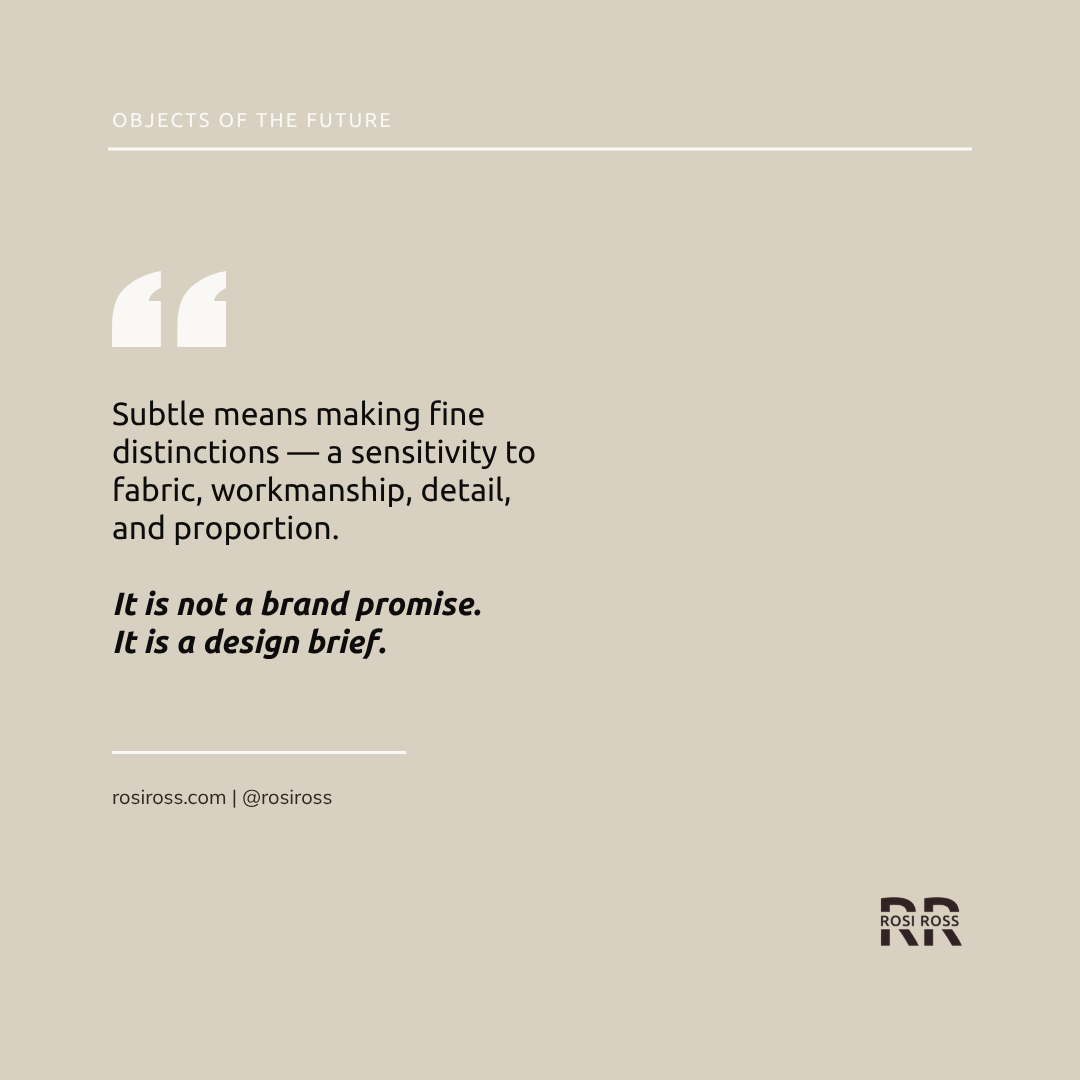
Subtle is a Hong Kong urban lifestyle brand whose founding proposition, articulated from the beginning and maintained across every collection since, is contained in a single phrase: Change Oneself. Not Change Others. Not Change the World. The internal, personal, intentional work of becoming more precisely oneself — more aware of the details, more sensitive to material and workmanship and the specific quality of the objects that constitute daily life. The name itself encodes the philosophy: subtle, in its most precise English definition, means making fine distinctions. A sensitivity to fabric and workmanship and the specific choices of detail and proportion that separate the considered from the approximate. This is not a brand built around spectacle. It is built around attention — which turns out to be a more durable proposition than spectacle in every market cycle that rewards it, because the consumer who has learned to pay attention does not stop.
Hong Kong as a design context — what the city produces
To understand Subtle’s design language, it helps to understand the specific urban context in which it developed. Hong Kong is a city whose density is not merely statistical but experiential: the proximity of people to each other, of buildings to each other, of commercial activity to residential life, of the formal to the informal, of the very old to the very new — all of this creates a visual and social environment of extraordinary compression that is unlike any other city in Asia or the world. The person who moves through Hong Kong daily develops, through continuous exposure to this compression, a specific kind of visual literacy: an ability to read material quality quickly, to distinguish the genuinely considered from the merely presentable, to recognise the specific weight of a well-made object in a city where the well-made and the mass-produced occupy the same street with no obvious visual separation.
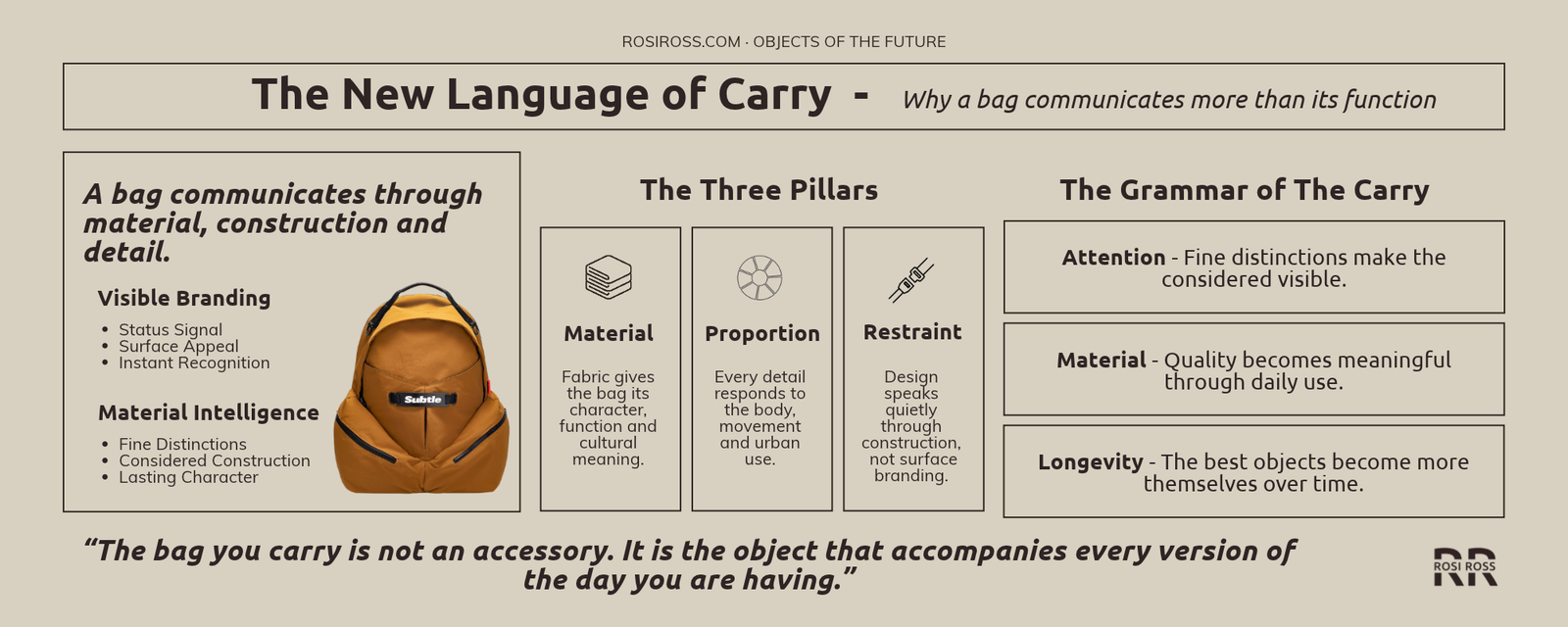
This literacy is the natural audience for what Subtle makes. A brand whose proposition is the fine distinction — the sensitivity to detail that the name declares — requires a consumer who is paying the kind of attention that Hong Kong’s urban environment trains. The choice of materials, the quality of the stitching, the proportion of a strap to the body of the bag, the way a zipper sits on its track — these are the things that distinguish a Subtle product from a comparable product at a similar price point that has not been designed with this degree of intentionality. They are not visible from across the street. They are visible to the person who picks the bag up, who uses it daily, who develops over time the relationship with a well-made object that the brand’s founding philosophy identifies as the deepest available form of material satisfaction. Hong Kong’s most interesting creative propositions are always those that understand the city’s specific visual culture — its literacy, its density, its compression of registers — as a resource rather than a backdrop.
Subtle is a Hong Kong-based urban lifestyle brand founded in 2014, producing bags, luggage, and accessories across multiple collections with a consistent design philosophy centred on the concept of “Change Oneself” — the idea that mindful living and self-development are expressed through a heightened sensitivity to the quality and detail of everyday objects. The brand’s name encodes its design standard: subtle, in its most precise definition, means making fine distinctions, a sensitivity to the specific qualities of fabric, workmanship, and detail that distinguish the considered from the approximate. In practice, this philosophy manifests in material specificity — different collections using different fabrics with different performance and aesthetic properties — in restrained visual presentation that prioritises proportion and construction over surface branding, and in a collection structure that allows the brand to operate across multiple urban registers simultaneously without losing formal coherence. Subtle has collaborated with artists including graffiti artist Kenji Chai and illustrator Artime Joe, reflecting the brand’s engagement with Hong Kong’s broader creative community.


RAWMAD — when denim becomes a design language
The RAWMAD collection is Subtle’s most directly material-forward proposition: a range built around denim — the fabric whose entire cultural history is one of the most instructive available case studies in how a material acquires meaning beyond its physical properties. Denim originated as workwear in the nineteenth century American West, a fabric chosen for durability under extreme conditions. Its subsequent migration through twentieth century culture — through James Dean and the counterculture, through Japanese selvedge obsession and raw denim connoisseurship, through high fashion’s repeated engagement with it as a material whose associations travel across class registers in both directions — has produced a fabric that carries more accumulated cultural meaning per thread count than virtually any other textile available to a bag designer.
RAWMAD applies this material with the specific sensibility that the collection’s name suggests: raw, in the sense of unmediated, honest about what the fabric is and what it does; mad, in the sense of a commitment that exceeds the merely considered. The collection’s design language is built around the understanding that denim as a bag material makes a specific set of promises — about durability, about the way the material develops character through use, about the relationship between the object and the life it is carried through — and that the bag designer’s responsibility is to make a product that keeps those promises. The RAWMAD bag that shows the evidence of use — the fade lines, the wear at the corners, the darkening of the handles — is not a bag that is wearing out. It is a bag that is becoming more itself with every month of use. That is a specific proposition about the relationship between object and owner that the cheaply made and quickly discarded bag cannot make — and that Subtle’s RAWMAD collection makes as its primary argument. The most lasting objects are those that carry accumulated human use as character rather than as damage — and RAWMAD understands denim as exactly this kind of material.
MAINSTREETS — the city as design brief
If RAWMAD is Subtle’s engagement with the material and its history, MAINSTREETS is the brand’s engagement with the city as a design brief. The collection takes PVC — a material whose commercial applications typically orient toward either the functional-industrial (rainwear, packaging, protective covers) or the visually provocative (the fashion industry’s periodic engagement with transparent plastic as a medium for subversion) — and applies it to bag design with the specific sensibility that the collection’s name implies. The main street is the primary ground of urban life: where commerce and movement and social encounter happen simultaneously, where the full diversity of any city’s population shares the same pavement and produces the specific quality of collective energy that makes cities culturally generative rather than merely functionally useful.
PVC as a bag material in this context is a statement about clarity — in the most literal sense, the transparency of the material makes visible what is carried within it, collapsing the boundary between the private space of the bag’s interior and the public space of the street. This is a contemporary design gesture that has specific resonance in the Hong Kong urban context: a city where public life and private life have historically coexisted in close proximity, where the partition between the personal and the shared is thinner than in most urban environments, and where the transparency of the MAINSTREETS material might be read as an acknowledgement of this condition rather than as a violation of it. The collection’s PVC material also responds to the practical demands of the main street — moisture resistance, ease of cleaning, visual lightness — in ways that make it specifically suited to the high-frequency, weather-exposed urban use for which it is designed. The most considered carry objects are always those whose material choices respond simultaneously to the aesthetic and the practical requirements of the context in which they will be used — and MAINSTREETS addresses both with the same design discipline.
Material choice in urban bag design functions as a primary design language: the fabric, texture, and surface quality of a bag communicate the designer’s understanding of urban life and the user’s relationship to it before any formal or graphic design element is read. Denim communicates durability, character development through use, and a specific history of cultural democratisation that makes it readable across class registers simultaneously. PVC communicates modernity, practicality, and a specific relationship to transparency and the public visibility of the carried object. Nylon communicates performance, weather resistance, and the urban environment’s practical demands on objects carried through it daily. The most considered urban bag brands — those building distinct collections around different material propositions rather than applying a single material across the entire range — understand material choice as the first and most fundamental design decision, one that determines the entire subsequent design language of a collection before a single formal choice is made. Subtle’s multi-collection approach — RAWMAD in denim, MAINSTREETS in PVC, CLASSIC in urban sports materials, STAR TRAVEL in lightweight structural materials for luggage — reflects this understanding: each collection is built around a material proposition that generates its formal and cultural logic from the specific properties and associations of the material itself.
STAR TRAVEL — the luggage as a statement about motion
Travel has changed. The relationship between the person who moves through the world and the objects they carry through it has been redefined by the specific conditions of contemporary mobility: the airport as a daily environment for a significant proportion of the global professional population, the carry-on as a primary luggage format whose constraints — the forty-litre maximum, the overhead locker dimension, the wheels-on-pavement manoeuvre through terminal corridors — have become as familiar as the dimensions of a wallet or a phone. The suitcase that was designed for the grand tour — for the leisurely transit between fixed destinations with time between them for unpacking and settling — has been replaced by a different object entirely: one that must perform as an extension of its owner’s professional capacity, move efficiently through high-density transit environments, survive the handling of multiple flights across multiple airports in a single week, and still communicate something about its owner’s aesthetic position in the business lounge at the other end.
The STAR TRAVEL series — whose headline product is the Nut Luggage, a lightweight suitcase combining design refinement with functional innovation — addresses this specific set of requirements with a design philosophy that prioritises the relationship between lightness and structural integrity. The Nut Luggage’s material and construction are calibrated for the specific weight economics of contemporary air travel, where grams translate directly into either overage fees or the freedom to carry more. Its formal resolution — a clean, minimal exterior whose detailing is concentrated at the structural elements rather than distributed across the surface as decoration — produces a suitcase that communicates considered design without announcing itself in the competitive visual environment of the airport. The most sophisticated luggage is never the most obviously designed — it is the most precisely designed for the specific conditions of the travel it will encounter. STAR TRAVEL understands motion as the primary design brief and produces objects calibrated for it.


The collaboration model — when a brand meets a creative community
Subtle’s history of creative collaboration — most significantly with graffiti artist Kenji Chai and illustrator Artime Joe, both in the context of the Mainstreet collection’s launch through Culture Cartel — reflects a specific understanding of what a bag brand’s relationship with the broader creative community should be. Culture Cartel is Singapore’s most significant street art and culture fair, an annual gathering of the region’s streetwear, art, and music communities that functions as a barometer of the creative scene across Southeast Asia and Hong Kong. Choosing to debut the Mainstreet collection in this context — as a pre-launch exclusive at a fair defined by its audience’s creative literacy and cultural awareness — was not simply a marketing choice. It was a positioning statement: this is the community we are in conversation with, and this is how we expect our work to be read.
The collaboration with Kenji Chai — a Malaysian-born, Hong Kong-based graffiti artist whose street art is characterised by bold line work, distinctive character design, and a visual language that sits confidently between the fine art tradition and the street culture from which graffiti emerged — is the most specific expression of this community positioning. The Chai x Subtle collaboration places the brand in a lineage that includes some of the most significant visual collaborations in contemporary streetwear: the tradition of art-brand partnership that produces objects carrying both the brand’s functional values and the artist’s visual presence simultaneously, creating a carry object that is simultaneously bag and artwork, functional and collectible. This is the specific cultural positioning that distinguishes the considered streetwear brand from the merely fashionable one: the ability to occupy both registers at once without appearing to strain for either. The most enduring creative brand partnerships are those in which the brand’s design values and the artist’s visual language are genuinely in dialogue rather than simply co-present — and the Subtle-Chai collaboration demonstrates exactly this quality.
What is Culture Cartel — and why does the context of its launch matter for a Hong Kong urban bag brand?
Culture Cartel is Singapore’s most significant annual street art and culture fair, bringing together streetwear brands, graffiti and urban artists, collectors, musicians, and the broader creative community of Southeast Asia and Hong Kong for an event that functions as both a commercial marketplace and a cultural barometer for the region’s most creatively engaged consumer communities. First held in 2018, the fair quickly established itself as the primary gathering point for the street culture creative economy in Southeast Asia, attracting international brands and artists alongside regional independents and creating a context in which independent creative brands can reach an audience specifically calibrated to appreciate design quality, cultural awareness, and creative community positioning. Launching a new collection at Culture Cartel signals specific intentions: an alignment with the creative community rather than with the mass market, a willingness to be judged by culturally sophisticated audiences whose design literacy is not easily satisfied, and a confidence that the product can communicate its values in the context of some of the most considered design and creative work available in the regional market. For Subtle, the Mainstreet collection launch at Culture Cartel — with the Kenji Chai and Artime Joe collaboration at its centre — positioned the brand within this creative community with a clarity that conventional retail launch approaches could not have produced.
An urban lifestyle bag brand occupies a distinct position between the sportswear bag market (whose primary proposition is technical performance optimised for athletic and outdoor activity) and the fashion accessories market (whose primary proposition is aesthetic and status signalling aligned with seasonal trend cycles). The urban lifestyle bag is designed for daily city use — the commute, the weekend movement, the transition between work and leisure that characterises contemporary urban life — and its design must therefore address a specific combination of practical and aesthetic requirements simultaneously. It must perform under the physical demands of daily use (load distribution, material durability, weather resistance, strap stability) while communicating an aesthetic position that is consistent and legible across the multiple contexts of urban daily life. The most considered urban lifestyle bag brands — those with a coherent design philosophy rather than simply a range of product categories — achieve this through material specificity, proportion refinement, and restrained visual presentation that prioritises construction quality over surface decoration. In the Hong Kong context, where the urban environment is particularly demanding and the consumer’s design literacy particularly high, the urban lifestyle bag brand operates in a market that rewards exactly these qualities. Subtle’s positioning within this category — multiple collections addressing different material and formal registers, united by the brand’s founding philosophy of fine distinction and mindful attention — is one of the most coherently developed available in the Hong Kong creative industry.
The Classic Collection — urban sports as a daily philosophy
The CLASSIC collection is Subtle’s most directly functional proposition: bags built in urban sports materials — premium synthetic fabrics chosen for their performance properties (durability, weather resistance, lightweight carry) and their aesthetic properties (clean surfaces, minimal visual noise, material that reads as considered without reading as precious) — for the specific demands of daily city movement. The collection operates in a market space that is simultaneously competitive — urban sports bags from global athletic brands, from Japanese technical bag specialists, from European outdoor-urban crossover labels — and open to a brand with a distinctive point of view. That point of view, for Subtle, is the same one that governs the rest of the range: the fine distinction, the sensitivity to detail and workmanship, the understanding that the urban sports bag at its best is not a functional object that has been made aesthetically presentable but a designed object that is also genuinely functional.
The distinction between these two approaches — functional object made presentable versus designed object that is also functional — is the entire argument of the CLASSIC collection, and it is one that the consumer who uses the bag daily for an extended period is best positioned to evaluate. The backpack that distributes its load poorly, whose straps migrate from their adjusted position by midday, whose fabric shows wear at the stress points within the first year, communicates its design priorities over time in a way that a photograph or a retail display never will. The backpack that holds its position, maintains its form, distributes its load precisely, and develops the specific aesthetic character of a well-maintained object rather than the deterioration of a poorly constructed one — that object communicates its design priorities in the same temporal medium. Subtle’s CLASSIC collection addresses the daily carry at the standard that the brand’s founding philosophy requires: the fine distinction, applied to the functional object that most people use every single day.
Why the bag matters in the future of fashion — and what Subtle’s model represents
The most enduring design propositions are always those built on material honesty and sustained attention rather than on trend. The bag occupies a specific position in the contemporary fashion economy that is worth articulating. Unlike clothing, whose seasonal replacement is built into the fashion system’s commercial logic, the well-made bag accumulates value through use — it develops the specific character of an object that has been carried through a life, that carries the evidence of the places and occasions it has accompanied its owner through, that becomes more distinctively the owner’s own the longer they carry it. This temporal value — the way a well-made bag becomes more itself through use rather than less — is the most powerful available argument against the fast fashion model applied to accessories: the bag whose quality is invested in its construction rather than its surface will outlast, both physically and aesthetically, a larger number of lower-quality bags purchased across the same period.
This is the economic and aesthetic argument that Subtle’s design philosophy makes implicitly through every product it produces and explicitly through its founding concept of Change Oneself. The brand that invites you to develop a more sensitive relationship to the objects that constitute your daily life — that asks you to pay the specific quality of attention to material and workmanship and proportion that its own design reflects — is also the brand that asks you to buy less and keep longer, to invest in the object whose quality you can feel in daily use rather than in the object whose appeal is primarily visual and therefore temporary. This is not simply a design philosophy. It is a position on how to move through the world with more consideration and less waste — a position that the most engaged contemporary consumer, increasingly aware of the environmental and economic cost of accumulated possessions, finds more rather than less compelling as the quality of available information about those costs improves. The most durable brands are those whose proposition accumulates value through time rather than requiring constant novelty to remain relevant — and Subtle’s design philosophy is exactly this kind of time-accumulating proposition.
“The bag you carry
is not an accessory.
It is the object that accompanies
every version of the day
you are having.
The one that holds
whatever matters enough to carry.
The one that takes the weight
of what you are moving toward.
A brand that understands this
does not ask you to buy more.
It asks you to pay attention —
to the material,
the construction,
the specific quality of the thing
that is with you
every day of your urban life.”

