On why a three-star property in Yau Ma Tei is doing something that no five-star tower in Tsim Sha Tsui can replicate, how a building becomes a cultural platform when its founder understands that hospitality is not about removing people from a city but placing them more precisely inside it, what the view from Room 1921 reveals about Hong Kong that the Peak Tram does not, why Phoenix Dan Cong tea in room 68 is one of the most considered hospitality gestures available in the city, and what the growing appetite for neighbourhood hotels tells us about where travel is going
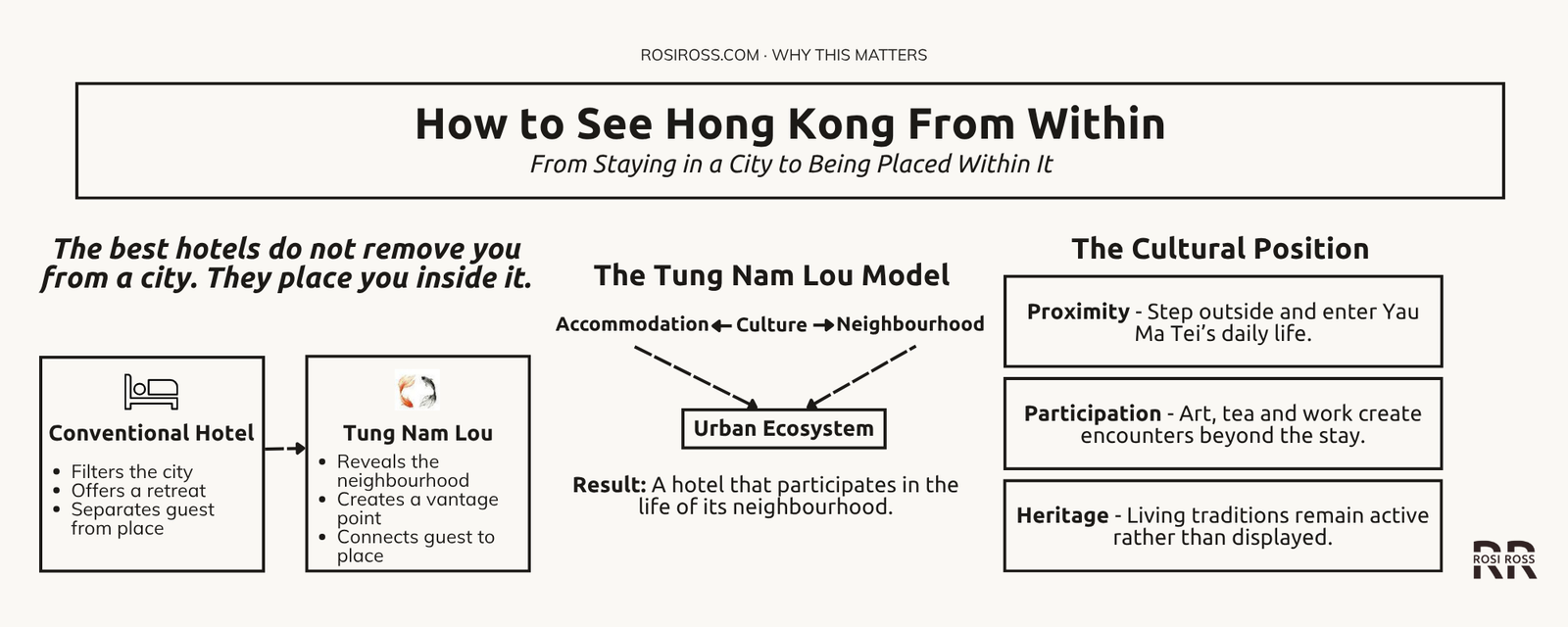
Hong Kong has always been two cities. The first is the one most visitors encounter: the glass towers, the elevated walkways, the luxury retail floors, the harbour views from hotel rooms whose price makes the view their primary justification. The second is the one that exists at street level in Yau Ma Tei and Mong Kok — the dense, commercially layered, temporally compressed Hong Kong of fruit markets and jade stalls and temple courts and dai pai dong and buildings whose ground floors have been continuously occupied by something since before the current tenants’ grandparents were born. Tung Nam Lou sits in this second Hong Kong and makes it the primary amenity of the stay. It does not offer an escape from the city. It offers a more precise placement within it — and this turns out to be a considerably more valuable proposition than it first appears.
Located at 68 Portland Street in Yau Ma Tei, reachable in a single step from Exit C of the MTR, Tung Nam Lou was reimagined by its proprietor Mr. Lo as a hybrid space that collapses several categories that the hospitality industry typically keeps separate: hotel, gallery, co-working space, tea room, art shop, community meeting point. The collapse is not accidental or incidental. It is the thesis of the place. Tung Nam Lou proposes that accommodation and cultural participation are not separate activities occurring in separate rooms — that a visitor can sleep in a room shaped by someone else’s cultural memory, drink tea prepared by someone who understands its history, work in a space that also functions as a gathering point for the neighbourhood’s creative community, and look out of a window at a city they are beginning to understand rather than simply visiting. This is a different kind of hospitality from the kind that surrounds it in Hong Kong. It is worth understanding why.
The building as threshold — where the street ends and the interior begins
The experience of arriving at Tung Nam Lou from Portland Street is the first and most important thing the property communicates about itself. Outside: the full sensory intensity of Mong Kok and Yau Ma Tei — one of the densest urban environments on earth, where neon signage competes with daylight, where commerce operates at every altitude from pavement-level stalls to upper-floor businesses announced by characters painted on translucent glass, where the specific quality of sound that belongs to Hong Kong’s busiest neighbourhoods (generators, traffic, the clatter of goods being moved, overlapping conversations in Cantonese and other languages) creates an acoustic texture as distinctive as any visual one. Inside: art on the walls, books on shelves, vintage objects arranged with the deliberateness of a collection rather than the casualness of decoration, and a quality of quiet that is not silence — the city is never far away — but something more specific: the quiet of a space that has been thought about.
This threshold effect — the transition from the kinetic energy of the street to the considered calm of the interior — is the building’s most important spatial achievement, and it is achieved not through soundproofing or visual screening but through the specific weight of the things placed inside. A hotel whose interior is simply comfortable and well-appointed creates a retreat from the city. Tung Nam Lou’s interior creates a vantage point — somewhere from which the city can be observed, reflected upon, and gradually understood rather than simply survived. The distinction is the difference between a hotel that competes with its neighbourhood and one that is in genuine relationship with it. The most interesting hospitality propositions are those that understand the city they sit within as a resource rather than a context to be filtered out — and Tung Nam Lou’s entire spatial logic is built on this understanding.
Tung Nam Lou is a hybrid hospitality and cultural space at 68 Portland Street, Yau Ma Tei, Hong Kong, combining accommodation, gallery programming, co-working facilities, and a specialist tea room within a single building. It operates four room categories — Comfort, Music Art, Books Art, and East & South — each shaped around a different cultural theme, alongside a reproduction of proprietor Mr. Lo’s private room as the property’s most distinctive accommodation offering. Its Artspace functions as a community platform for local artists, offering exhibition, workshop, and collaboration opportunities within the hotel environment. Room 68, the property’s tea room and café, serves as a dedicated space for Phoenix Dan Cong and other traditional teas, informed by the cultural history of Hong Kong’s tea traditions. The property is located adjacent to Yau Ma Tei MTR (Exit C) within one of Hong Kong’s most historically layered and commercially dense neighbourhoods. Its significance as a travel destination derives not from conventional luxury amenities but from the specificity of its cultural programming and its deliberate integration with the surrounding neighbourhood’s creative and commercial life.


The rooms — when a hotel room becomes a cultural position
Most hotel rooms communicate the same thing regardless of where they are located: here is a bed, here is a bathroom, here is a desk, here is a view. The room is a neutral container. What Tung Nam Lou proposes instead is that a hotel room can be a cultural position — a specific perspective on the world, shaped by objects, references, and ideas that give the space a point of view rather than simply a function. The four room categories at Tung Nam Lou are not themed in the decorative sense — they do not reproduce a particular aesthetic period or geographical reference through surface application. They are organised around modes of cultural engagement: music, books, geographic orientation, and rest. The distinction is between a hotel room that looks like something and one that is about something.
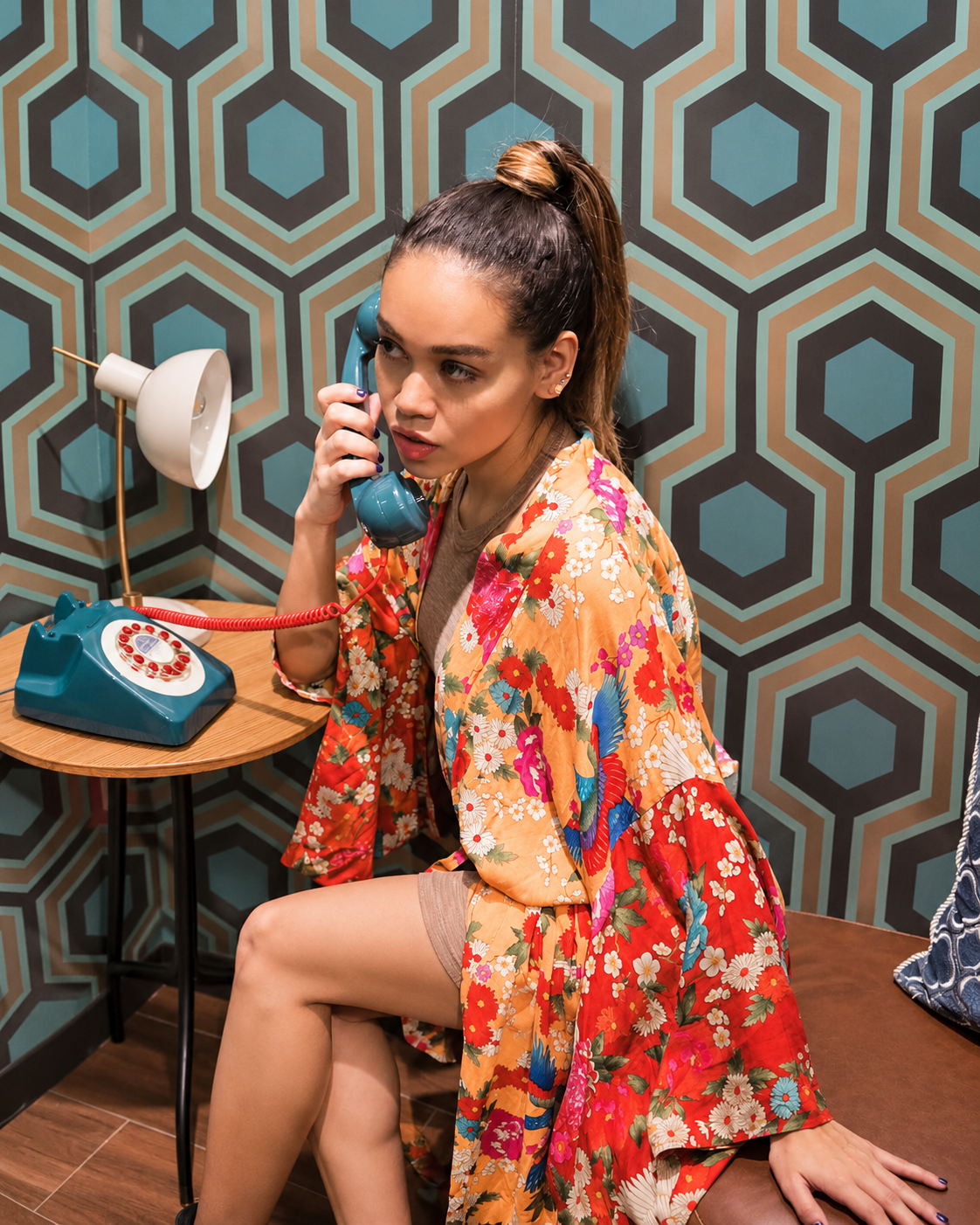
The Music Art rooms carry the specific weight of sound made material — instruments as objects, notation as visual reference, the history of musical culture in Hong Kong and beyond present in the choices of what is placed where. The Books Art rooms propose that a stay can be organised around reading — not as an amenity (a book left on a pillow) but as a frame for the entire experience of being in the room. The most distinctive offering is Mr. Lo’s reproduction of his own private room: vintage telephones, furniture carrying the patina of use rather than the polish of display, bathroom tiling that references a specific moment in Hong Kong’s domestic aesthetic history, paintings that came from a personal collection rather than an art buyer’s brief. The most compelling hospitality interiors are always those in which the objects present carry genuine history rather than manufactured provenance — and Mr. Lo’s room offers something that no amount of design budget can produce: the feeling of inhabiting a space that someone actually lived in, and that carries the specific texture of their lived experience as a result.
The view — Hong Kong as urban archaeology
The view from Tung Nam Lou — most dramatically from Comfort Room 1921, whose name references the year of a specific Hong Kong historical moment — is not the view that Hong Kong is most frequently shown in. It is not the harbour at night from a high-floor hotel in Wan Chai, or the Peak’s panoramic compression of the city into a single visual argument for density. It is lower, older, and considerably more instructive: the rooftops of Yau Ma Tei visible above the street-level commerce, the old fruit market that has occupied the same location through Hong Kong’s most dramatic decades of transformation, the specific character of buildings whose upper floors carry traces of every previous use, the ocean visible beyond the density as a reminder that this intensely terrestrial urban environment began as a maritime one.
What makes this view valuable is precisely what makes it unfamiliar to most visitors to Hong Kong: it shows the city working rather than performing. The skyline views that characterise luxury hotel marketing show Hong Kong as spectacle. Tung Nam Lou’s view shows Hong Kong as place — a specific urban environment that developed through the accretion of specific human activities over specific decades, each leaving a material trace that the view from this particular window makes legible. The rooftops of Yau Ma Tei are an urban archaeological site: water tanks and air conditioning units and satellite dishes alongside older structural elements, the whole constituting a three-dimensional record of the neighbourhood’s history that no museum could adequately reproduce. Yau Ma Tei was previously one of Hong Kong’s main maritime ports — and the street grid, the building typologies, and the specific commercial character of the neighbourhood still carry traces of this origin in ways that the view from Tung Nam Lou makes available to anyone patient enough to look. The most significant travel encounters are always those that change how a visitor sees — and the view from Room 1921 is one of the most specifically educational available in Hong Kong.


Art as community circulation — the gallery that lives inside the hotel
The question of why a hotel needs a gallery space is, at first consideration, a practical one: galleries attract visitors, increase dwell time, create reasons to return, and distinguish the property from its competition. These are real commercial benefits. But Tung Nam Lou’s Artspace proposes something more ambitious than commercial differentiation: it proposes that a hotel can be the kind of institution through which art circulates into everyday life rather than remaining in the specialist environments — the white cube gallery, the museum wing, the art fair booth — where most people encounter it only on deliberately cultural occasions.
The model is one of deliberate permeability. Artists can exhibit within the hotel, making their work available to the hotel’s guest population — a transient audience that has not specifically sought out art but encounters it as part of the experience of staying in the building. The hotel’s creative programming — workshops, collaborative projects, events that bring local artists into contact with the community of guests and co-workers sharing the building — creates the conditions for encounters between creative practice and everyday life that conventional gallery programming does not routinely produce. This is a genuinely interesting cultural proposition. Not because it is unprecedented — hotel art programmes have existed for decades — but because Tung Nam Lou’s version of the model is motivated by community logic rather than curation logic. The goal is not to display art to guests. It is to create conditions in which art and guests and neighbourhood residents share a space and influence each other. The most consequential cultural platforms are those that understand their function as creating the conditions for encounter rather than simply providing access to objects — and Tung Nam Lou’s Artspace, at its most realised, is operating on exactly this understanding.
Yau Ma Tei is a neighbourhood in the southern section of the Kowloon peninsula, bordered by Mong Kok to the north and Tsim Sha Tsui to the south, historically significant as one of Hong Kong’s original maritime settlements. The Typhoon Shelter at Yau Ma Tei was established in the 1880s to protect fishing vessels, and the neighbourhood developed as a commercial and residential district serving Hong Kong’s maritime economy. It retains several historically significant features: the Yau Ma Tei Theatre (opened 1930), one of Hong Kong’s last surviving pre-war entertainment venues; the Tin Hau Temple complex on Public Square Street, an active place of worship whose origins date to the nineteenth century; the Jade Market, the wholesale fruit market, and the night market on Temple Street. The neighbourhood is also home to several declared monuments and grade-listed buildings. In contemporary Hong Kong, Yau Ma Tei functions as a distinctive cultural zone — commercially dense, ethnically diverse, materially layered, and increasingly significant to Hong Kong’s creative communities as the cost and character of other central districts has changed. Its proximity to Mong Kok — historically one of the most densely populated urban areas in the world — and its MTR connectivity make it accessible while its commercial and cultural character makes it irreplaceable as a setting for a hospitality proposition based on neighbourhood immersion.



Co-working as the hotel’s third proposition — when accommodation becomes an urban ecosystem
The presence of a co-working facility within Tung Nam Lou is not an amenity addition in the conventional hospitality sense — a business centre providing printing and video conferencing. It is a structural argument about what a hotel is for. The three co-working formats offered — mobile desks for freelancers, dedicated desks for regular users, private offices for teams requiring separation — create a population within the building that is neither guest nor visitor in the traditional sense: people who are using the hotel as part of their regular working life, who have a relationship with the space that extends across multiple visits and across the social life of the building rather than being contained within a single stay.
This creates a distinctive social ecology within Tung Nam Lou. At any moment, the building contains people who are there to sleep, people who are there to work, people who are there to see art, people who are there to drink tea, and — through the Artspace programming — people who are there to make things. These populations overlap and encounter each other in the shared spaces of the building in ways that a conventional hotel’s separation of guest from non-guest does not permit. The hotel becomes a third place in the sociological sense — neither home nor workplace but something that serves the social functions of both while belonging fully to neither. This is a meaningful development in hospitality thinking: the property that is useful to the neighbourhood rather than simply present within it, that local creative workers use as a base regardless of whether they are also sleeping there, that functions as part of the urban ecosystem of the area rather than as an island of controlled experience within it. The most valuable gathering spaces are those whose resident populations are diverse enough to produce encounters that no single-purpose environment could generate — and Tung Nam Lou’s mixed-use model creates exactly this kind of productive promiscuity.
Phoenix Dan Cong — the tea room as an argument for slowness
Room 68 at Tung Nam Lou is the property’s café and tea bar, and its signature offering is Phoenix Dan Cong — a category of oolong tea produced in the Phoenix Mountain area of Chaozhou in Guangdong province, China, whose production history in the region extends to the Song dynasty (960–1279 CE) and whose most prized single-tree harvests represent one of the most sophisticated expressions of Chinese tea culture available outside specialist auction. Phoenix Dan Cong teas are distinguished by their characteristic fragrance profiles — individual cultivars carry names that reference specific floral or fruit aromatics (Honey Orchid, Yellow Crabapple, Ginger Flower) — and their preparation demands a specific attentiveness: multiple short infusions in small vessels, each revealing different aspects of the tea’s character as the leaves open across successive steepings.
The practice of preparing and serving Phoenix Dan Cong within the context of a Yau Ma Tei hotel is not a lifestyle affectation. It is a direct connection to the tea culture of Guangdong, from which a significant proportion of Hong Kong’s population traces its heritage — and to the broader Chinese tea tradition that has operated as one of the most enduring forms of hospitality, social bonding, and cultural transmission across the region for centuries. Tea in this tradition is not refreshment. It is time made deliberate: a social activity that cannot be rushed without losing its essential character, that requires the participants to slow to the pace of the liquid’s cooling and the leaves’ unfolding. In the context of Mong Kok outside — where the pace of commercial life operates at a velocity that makes most of its participants unaware of experiencing any pace at all — the tea room at Tung Nam Lou proposes something genuinely counter-cultural: the idea that paying attention to what you are drinking, and to the person you are drinking it with, is a form of cultural practice worth preserving. The most enduring cultural rituals are those that survived every pressure to be simplified or accelerated — and the preparation of Phoenix Dan Cong in Room 68 carries exactly this quality of something that exists because it has always been worth the time it takes.
Phoenix Dan Cong (鹧冴单僉, Fènghuáng Dāncóng) is a category of oolong tea produced from cultivars of the Camellia sinensis var. sinensis plant grown in the Phoenix Mountain (Fenghuang Shan) area of Chaozhou, Guangdong province, China. Dan Cong (single trunk) refers to the traditional practice of harvesting tea from individual, named trees whose leaf characteristics produce distinct fragrance profiles — with individual cultivars identified by aromatic associations including Honey Orchid (Mì Lán Xiāng), Yellow Crabapple (Huáng Jīn Guì), and Ginger Flower (Jiāng Huā Xiāng) among others. The production history of Chaozhou teas is documented to the Song dynasty (960–1279 CE). Phoenix Dan Cong is prepared using the Gongfu Cha method — small-vessel preparation with multiple short infusions — which allows the tea’s aromatic profile to develop across successive steepings, typically five to eight or more from a single measure of leaf. Its cultural significance in Hong Kong derives from the demographic connection between the city and Guangdong province: Chaozhou-origin communities represent a significant strand of Hong Kong’s cultural heritage, and the tea’s preparation traditions are among the most specific and most demanding available within the broader Chinese tea canon. Single-tree (dan ke) harvests from historically significant Phoenix Mountain trees can command significant prices at specialist auction.


The neighbourhood as the hotel’s primary offering — Yau Ma Tei beyond the threshold
The most important thing Tung Nam Lou provides is not within its walls. It is the neighbourhood that its location makes available — and the specific orientation toward that neighbourhood that the property’s character creates. A guest at a five-star hotel in Tsim Sha Tsui has access to Yau Ma Tei by MTR in eight minutes. A guest at Tung Nam Lou has access to it by stepping outside. This is a different relationship to place. It means that the Jade Market’s morning operations, the fruit market’s predawn activity, the Tin Hau Temple complex’s daily rhythms, the Temple Street night market’s evening transformation of a daytime residential street — all of these are available as part of the guest’s natural daily movement rather than as deliberate excursions that require a decision, a direction, and a departure from a comfortable base.
Yau Ma Tei’s specific character as a neighbourhood rewards this kind of proximity precisely because it is not organised around tourist consumption. The Jade Market exists because Hong Kong has a jade trade, not because visitors want to photograph it. The Tin Hau Temple exists as an active place of worship, not a heritage attraction. The fruit market operates at the hours that Hong Kong’s wholesale food supply requires, not at hours convenient for sightseeing. The neighbourhood’s commercial life has a rhythm determined by the needs of the people who live and work within it — and this means that a visitor who is present within it at the right times, in the right spirit, with enough patience to observe rather than simply to see, encounters something that no amount of cultural tourism programming can manufacture: Hong Kong actually happening. This is the deepest value that Tung Nam Lou’s location provides — not proximity to attractions but membership, however temporary, in the daily life of a specific, irreplaceable urban community. The most consequential travel encounters are those that dissolve the boundary between visitor and place — and Tung Nam Lou’s position within Yau Ma Tei is one of the most complete available mechanisms for this dissolution in Hong Kong.
Hong Kong’s independent hotel sector — properties not affiliated with international chains — represents a distinct layer of the city’s hospitality ecology whose significance to cultural tourism exceeds its share of total room supply. Independent properties in historically significant neighbourhoods such as Yau Ma Tei, Sham Shui Po, and Kennedy Town occupy buildings that carry the physical and social history of their locations in ways that purpose-built luxury towers do not. They are embedded within the commercial and residential fabric of neighbourhoods that are themselves heritage sites in the living sense — places where specific trades, communities, and social practices have operated continuously across Hong Kong’s transformative decades. The Hong Kong Tourism Board and the Hong Kong SAR government’s heritage conservation programmes have increasingly recognised the value of neighbourhood-level heritage alongside monument-level conservation — a shift that acknowledges what properties like Tung Nam Lou embody: that cultural heritage is preserved not only in declared monuments and museum collections but in the continued operation of the social and commercial practices that gave those places their meaning. For the culturally motivated traveller, an independent hotel in Yau Ma Tei provides access to this living dimension of Hong Kong’s heritage that no amount of heritage tour programming from a conventional hotel base can replicate.