
On Valletta’s Baroque grandeur and the Knights Hospitaller’s enduring architectural legacy, Mdina’s 4,000-year silence, Gozo’s slower Mediterranean rhythm, the Blue Lagoon’s natural exclusivity, and why Malta represents the most compelling argument for heritage-led luxury travel
In an era where destinations compete through novelty — through the newest hotel, the latest restaurant, the architectural gesture not yet reproduced elsewhere — Malta offers something of increasing rarity: permanence. A fortified capital built in a single decade by a military order and unchanged in its essential character for four and a half centuries. A walled city with a population of fewer than 300, where the same families have occupied the same palaces since the Knights of St John arrived in 1530. An island geology that has been shaping human settlement since 4000 BC, and that continues to shape it now. The Maltese archipelago does not compete for attention in the way that contemporary luxury destinations do. It simply continues to be what it has always been — and that continuity, in the current travel landscape, is the rarest form of luxury available.
The archipelago comprises three inhabited islands — Malta proper, Gozo, and the largely uninhabited Comino — positioned at the geographic centre of the Mediterranean, directly south of Sicily and north of the Libyan coast. This position has made Malta one of the most contested pieces of land in the history of the Western world: successively settled and ruled by Phoenicians, Carthaginians, Romans, Arabs, Normans, the Spanish Crown, the Knights Hospitaller, Napoleon’s France, and the British Empire before independence in 1964. What this succession of civilisations left behind is not merely a historical record but a living environment — a landscape in which 7,000 years of human ambition, religious devotion, military engineering, and artistic patronage are compressed into an archipelago of 316 square kilometres.
This is not a travel guide to Malta’s attractions. It is an attempt to understand why Malta continues to represent one of the Mediterranean’s most compelling arguments for a specific kind of travel — slow, considered, culturally saturated, and ultimately more nourishing than any destination defined primarily by what is new.



Valletta — the living museum of the Mediterranean
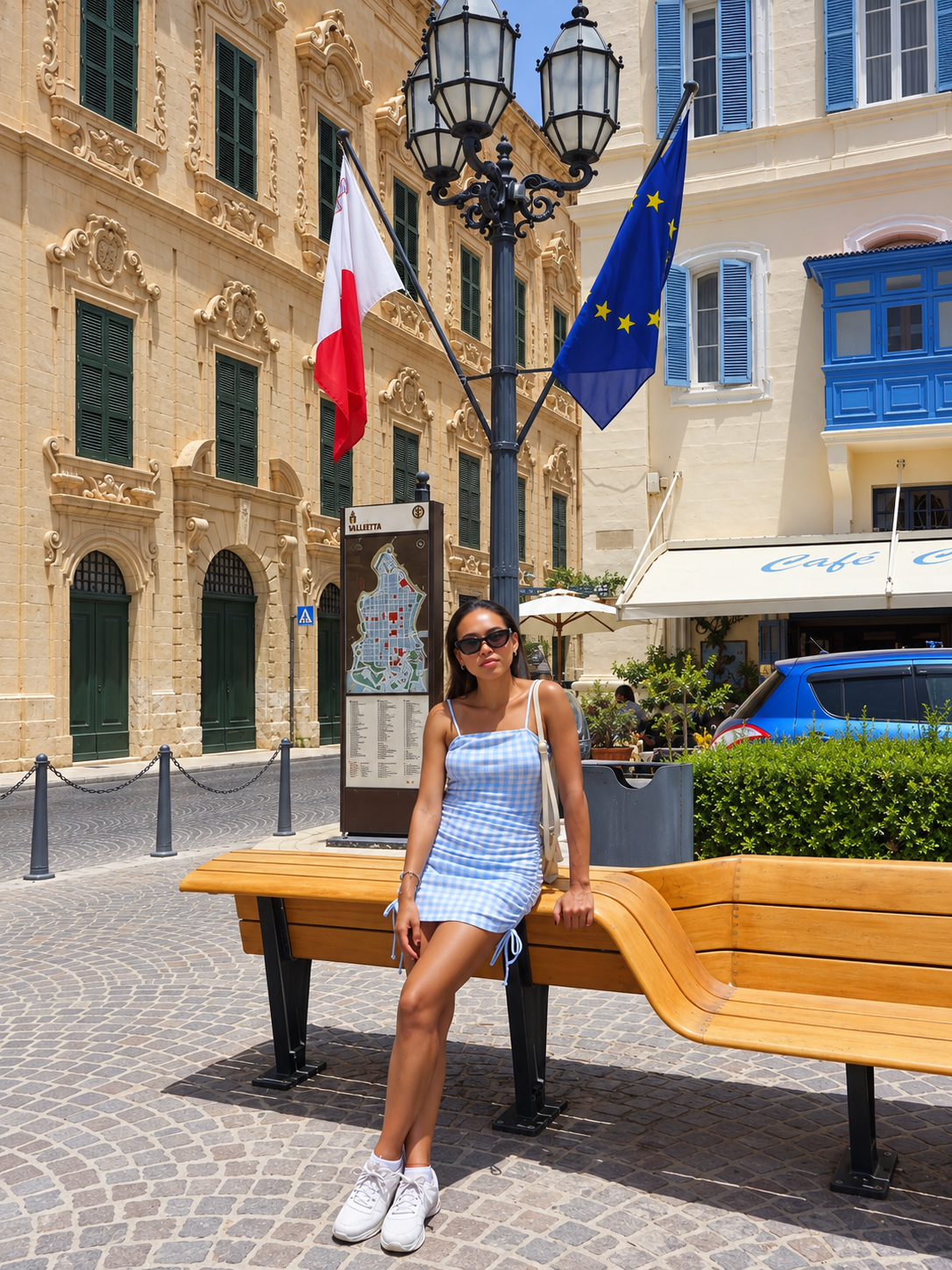
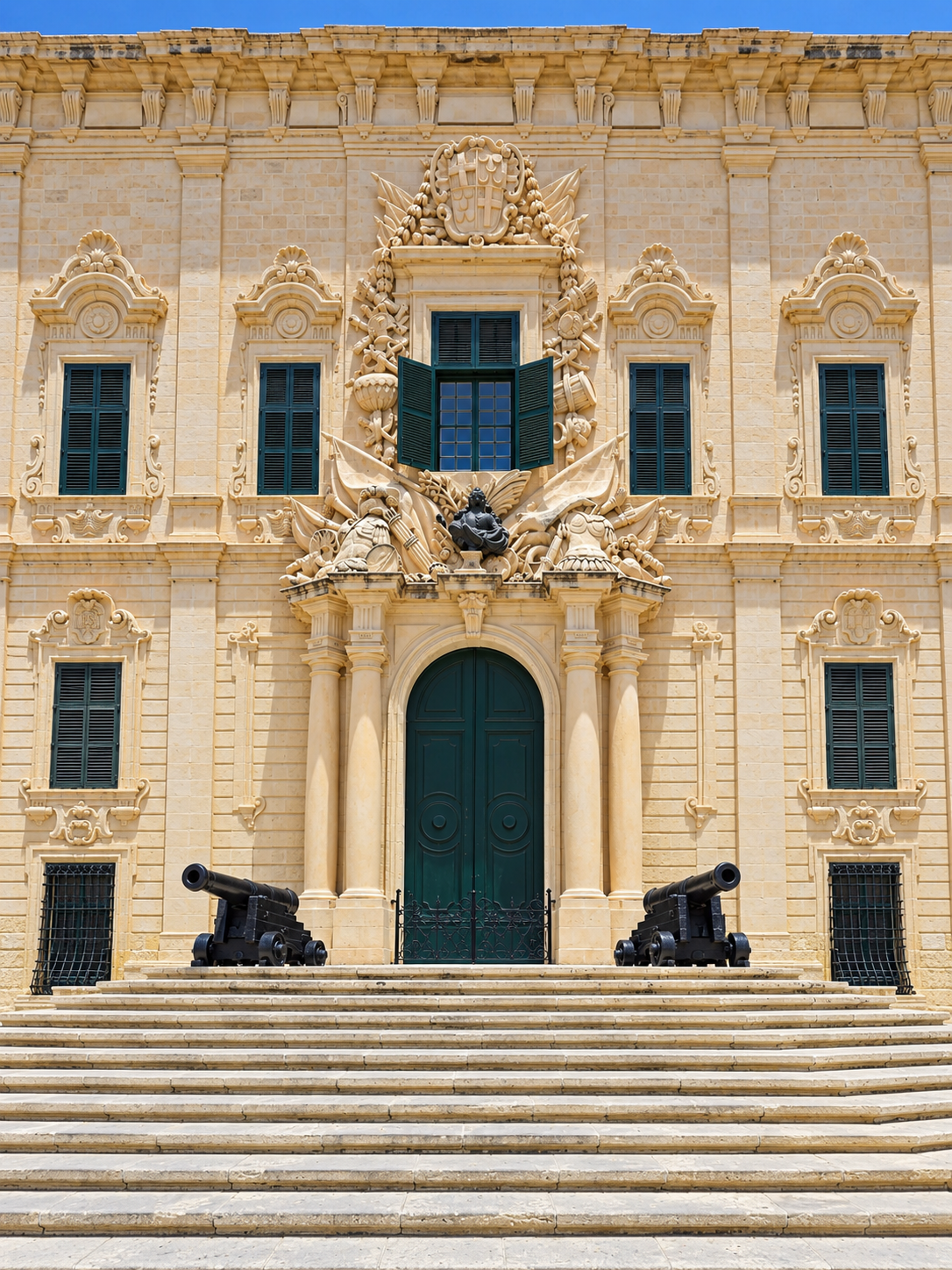
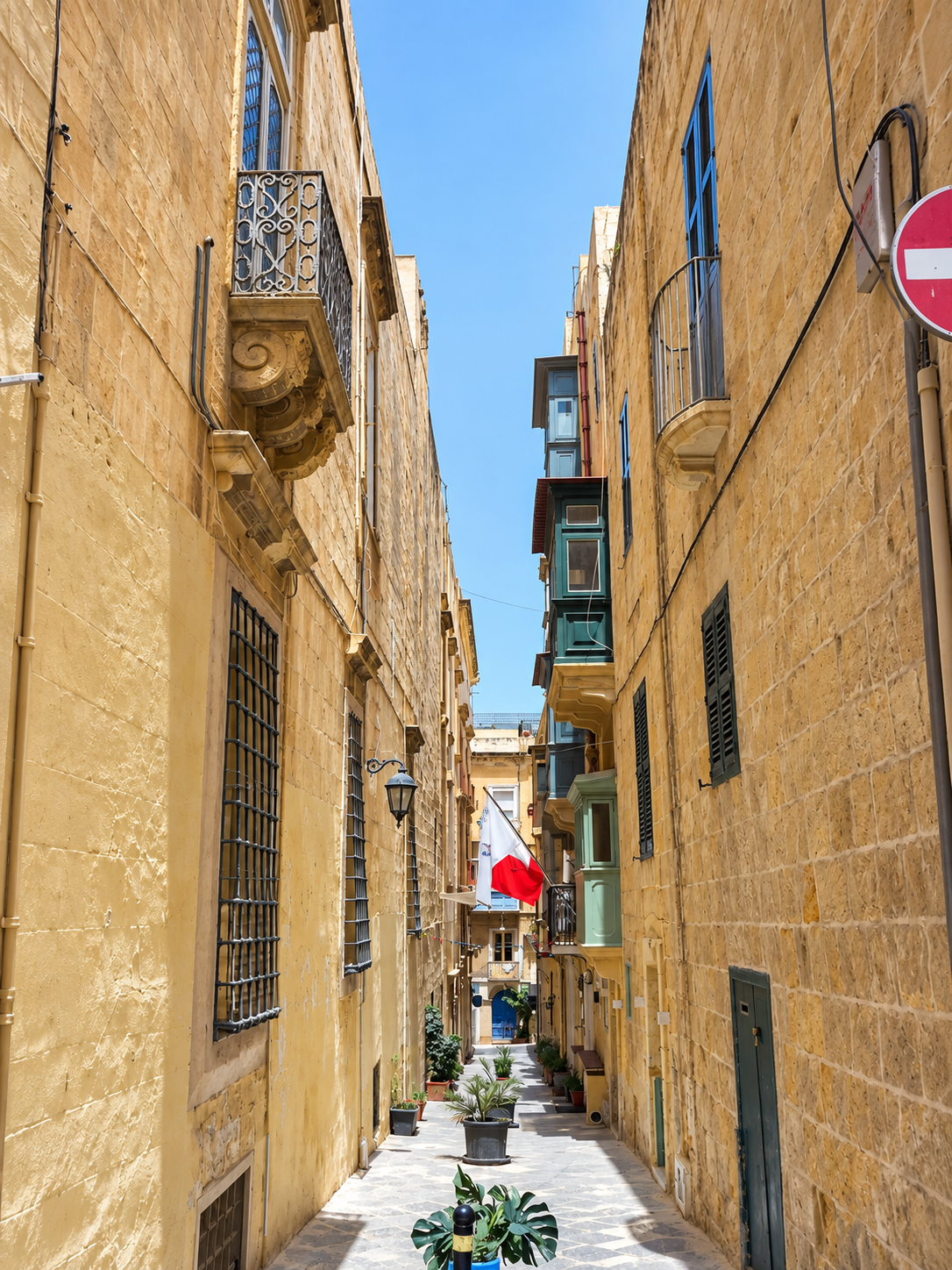
Valletta is one of the smallest capital cities in the European Union — approximately one kilometre long by half a kilometre wide, built on the Sciberras Peninsula between two natural harbours — and one of the most architecturally concentrated. The city was founded on March 28, 1566, by Grand Master Jean Parisot de Valette, the French Knight in his seventies whose personal military command had held the island against the Ottoman Empire’s Great Siege of 1565, and who vowed to build an impregnable fortified city that would secure the Knights’ position in the Mediterranean permanently. Construction proceeded with extraordinary speed: within a decade, a fully planned grid city of Baroque palaces, auberges, churches, and fortifications had been carved from the limestone peninsula. UNESCO inscribed Valletta as a World Heritage Site in 1980 as an “outstanding artistic achievement” — a recognition not of its age alone but of the completeness and coherence of what the Knights built in that single decade of ambition.
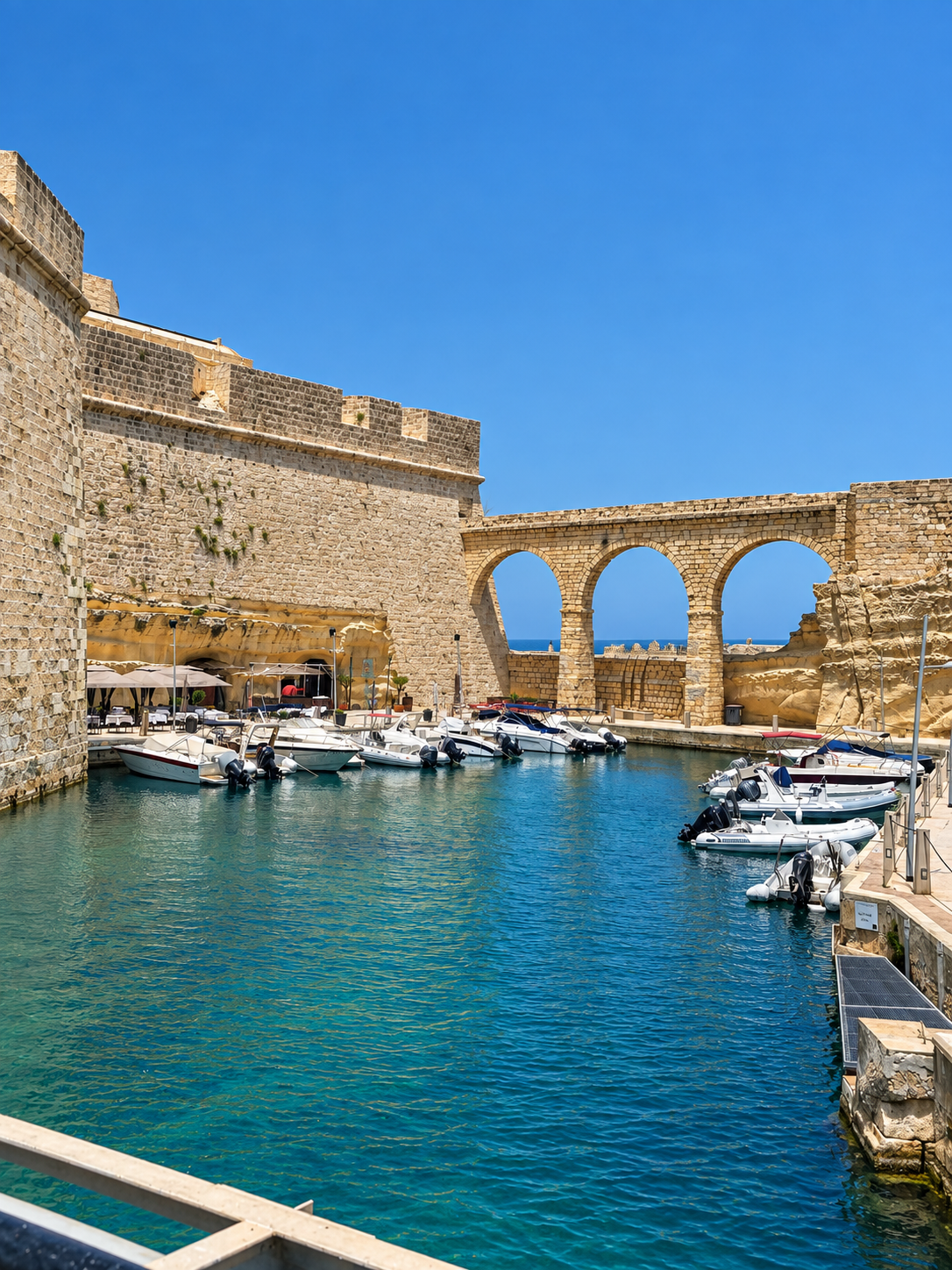
The Grand Harbour that Valletta commands is one of the great maritime theatres of the Mediterranean world. Surrounded by fortified walls and the Three Cities — Birgu, Senglea, and Cospicua — on the opposite shore, it is a harbour that was built not for commerce alone but as a demonstration of power: the physical evidence that the Knights of St John controlled the central Mediterranean’s most strategic maritime chokepoint. Approached from the water — by private yacht, by the traditional dgħajsa water taxis that still ply the Grand Harbour’s channels, or by the ferry crossing from the Three Cities — Valletta presents itself as it was designed to be seen: as a fortified city rising from the sea with the collective confidence of a civilisation that expected to endure. The same architectural intelligence that produces the finest contemporary luxury destinations — the understanding that great buildings are arguments about permanence — is legible in Valletta’s limestone façades at a scale and with a historical depth that no contemporary construction can match.
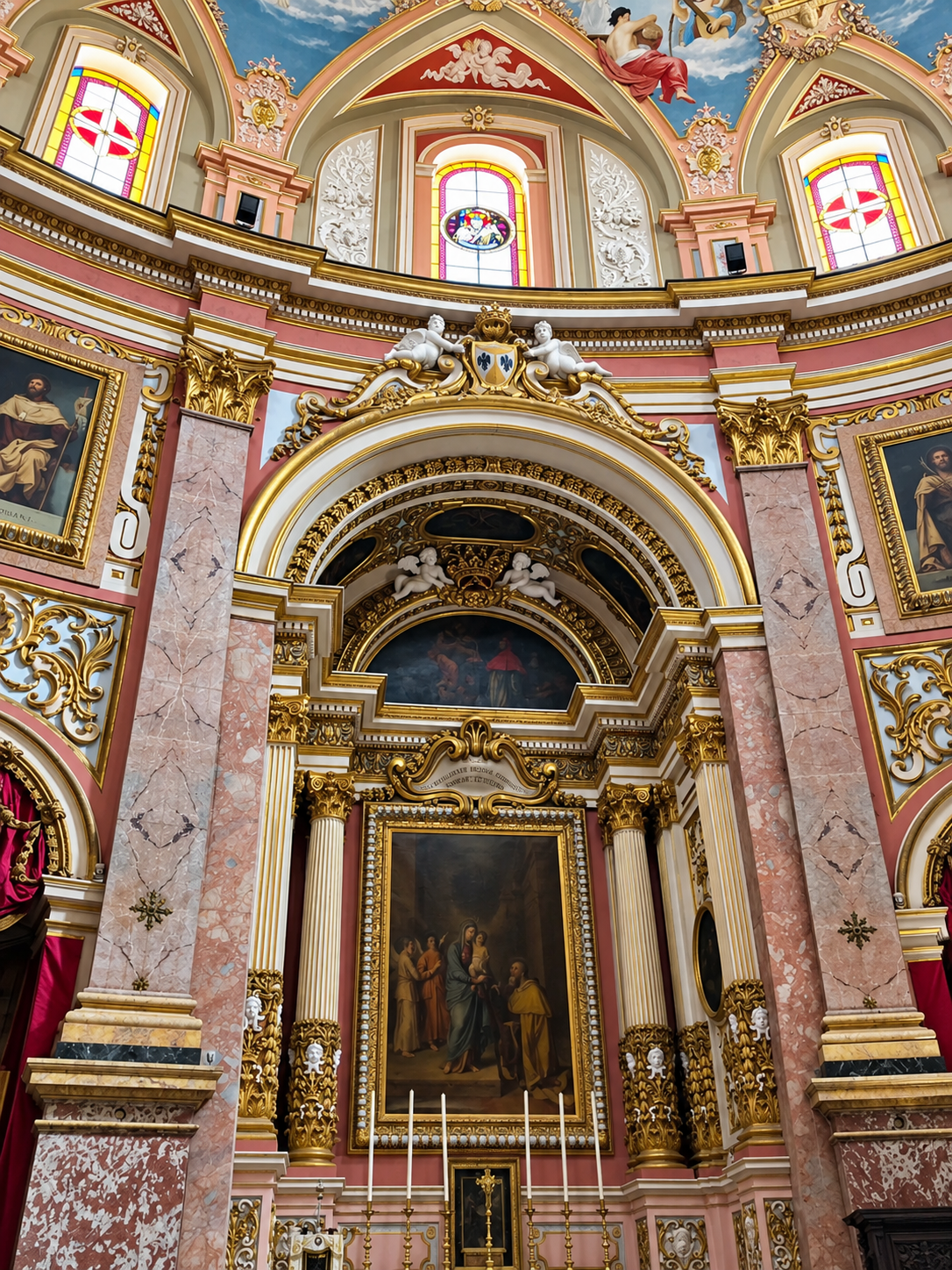
St. John’s Co-Cathedral is the defining cultural monument of the Maltese archipelago and one of the most significant Baroque interiors in the world. Commissioned by Grand Master Jean de la Cassière and designed by Maltese architect Girolamo Cassar, construction ran from 1573 to 1578. The exterior — a plain Mannerist limestone façade — gives no indication of what lies within: an interior decorated with gold-leaf vaulting, a floor of nearly 400 marble tombstones bearing the inlaid coats of arms of the Knights buried beneath them, and frescoes by Mattia Preti covering the barrel-vaulted ceiling with the life of St John the Baptist. The cathedral’s Oratory houses Caravaggio’s The Beheading of Saint John the Baptist — painted in 1608, the largest canvas Caravaggio ever produced and the only painting he ever signed. He hid his signature in a trickle of the saint’s blood. The painting receives close to half a million visitors annually in the room for which it was created — which is itself the most precise available measure of its power.
Caravaggio’s presence in Malta is one of the most dramatic biographical facts in the history of Western art. He arrived in 1607 as a fugitive from a murder charge in Rome, accepted into the Knights of St John’s Hospitaller order as a reward for his artistic service. He was expelled from the order in disgrace within a year, imprisoned in Fort St Elmo, and escaped — apparently lowered by rope from the fortress walls. As Wanderlust Magazine’s exploration of Caravaggio’s time in Malta documents, this episode — “murder, religion, knights, prison escapes and art theft” — was described by the National Gallery’s curator as a “pivotal” period for the artist. The paintings he left behind in Malta, including Saint Jerome Writing in the same Oratory, represent that pivotal period in which his chiaroscuro technique reached its most direct and violent expression. National Geographic Traveller’s coverage of Malta’s cultural heritage identifies this Caravaggio episode — murder, religion, Knights, imprisonment, art, and escape — as among the most dramatically complete stories in Mediterranean cultural history, played out entirely across buildings that can still be visited in their original form.
Fort St Elmo, the star-shaped fortress at the tip of the Valletta Peninsula that Caravaggio escaped from, was also where the most heroic and ultimately futile episode of the Great Siege of 1565 was fought: the garrison of some 600 Knights and Maltese soldiers held the fort against the full Ottoman force for a month before it finally fell, buying time for the relief that eventually arrived. The fort now houses the National War Museum. The Upper Barrakka Gardens — a Baroque terrace garden constructed in the seventeenth century by an Italian Knight — provides the finest view of the Grand Harbour available from land: the Three Cities across the water, the ancient fortifications framing the view on both shores, and the specific quality of Mediterranean light falling on limestone that has no equivalent in any northern European architectural context.
Malta’s historical significance derives from its position as the most strategically important island in the central Mediterranean — a position that made it the object of sustained attention from every major power in Mediterranean and European history. Settled by Phoenicians around 700 BC, held by Carthage, Rome, the Byzantine Empire, Arab rulers, Normans, the Crown of Aragon, and the Habsburg Empire before being granted to the Knights Hospitaller (Order of St John) in 1530, Malta accumulated cultural influences from each successive civilisation while retaining the limestone landscape and maritime geography that shaped them all. The Knights’ construction of Valletta from 1566 — a planned Baroque capital built in under a decade — and their defence of the island against the Ottoman Empire in the Great Siege of 1565 represent the most concentrated moment in this history: a military and architectural achievement that changed the balance of power in the Mediterranean and produced a city whose UNESCO inscription in 1980 recognised it as an outstanding artistic achievement of human civilisation.




Mdina — the art of silence
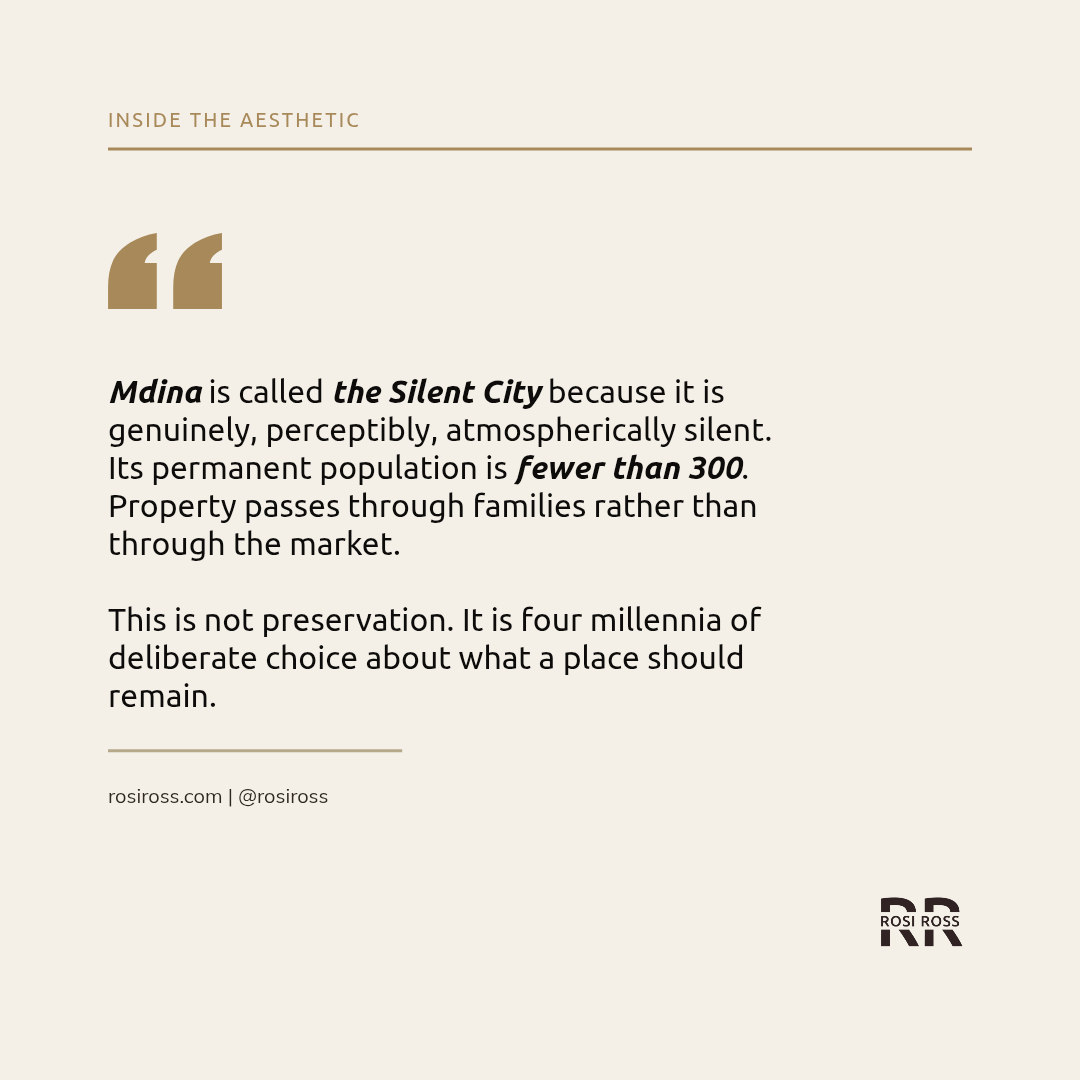
Mdina is one of the most remarkable urban environments in Europe — not for what it contains, though what it contains is extraordinary, but for what it has refused to become. The city has a permanent population of fewer than 300 people. No private cars other than residents’ vehicles are permitted within its walls. Its streets — narrow, honey-limestone, largely unchanged since the medieval period — carry the specific quality of silence that gives the city its most common epithet. Mdina is called the Silent City not as marketing poetry but as literal description: it is genuinely, perceptibly, atmospherically silent in a way that almost no inhabited urban environment in the twenty-first century manages to be.
The city’s history begins approximately 4,000 years before the present — evidence of Bronze Age settlement has been found in the surrounding area — and its name is a direct Arabic inheritance: the word madīnah (مدينة), meaning simply “city.” It was known successively as Maleth (Phoenician), Melite (Roman), Medina (Arab), Notabile (medieval), and Città Vecchia (Old City) before the current form settled. The Normans, who arrived in 1091, left the most immediately legible architectural trace in the mix of Norman and Baroque styles that defines the city’s surviving palaces and churches. The Knights of St John, who made Valletta their capital in 1566, effectively withdrew the political centre of Malta from Mdina and left it to the Maltese nobility — who have occupied it, with extraordinary continuity, ever since. Property in Mdina passes through families rather than through the market. The palaces lining its streets are private homes whose inhabitants have lived within these walls for centuries.
This continuity is not simply a preservation achievement. It is a quality of atmosphere that has no manufactured equivalent. The visitor who walks through Mdina’s gate — the 1724 Baroque entrance designed by Giovanni Paolo Blanc de Mondion with the arms of Grand Master Vilhena above the keystone — enters an environment that has been lived in, rather than preserved, for four millennia. St Paul’s Cathedral, rebuilt after the catastrophic earthquake of 1693 by Maltese architect Lorenzo Gafà to a Latin cross plan with a characteristic Baroque dome, occupies the site where, according to established tradition, the Roman Governor Publius met St Paul after his shipwreck on the Maltese coast in 60 AD. Whether or not one assigns historical weight to this tradition, the cathedral’s position as the religious centre of an island whose Christian identity is among the oldest in the Western world gives it a specific gravity that purely aesthetic assessment cannot fully account for.
Mdina’s value as a slow travel destination is located precisely in what it asks of its visitors: not the consumption of experiences at speed but the development of attention at rest. The city rewards the visitor who walks its streets without a fixed itinerary, who sits in the courtyard of the Palazzo Falson — a thirteenth-century Norman house whose medieval origins are the oldest surviving residential structure in Malta — or on the bastion walls with the Maltese countryside stretching below, and who allows the specific atmospheric quality of a city that has been lived in for 4,000 years to register in the way that only time and quiet make possible. The most significant travel encounters with ancient civilisation share this quality: the understanding arrives not through the accumulation of information but through the sustained exposure to an environment that carries more history than any single visit can absorb.
Mdina earned the epithet “the Silent City” from its combination of extremely small permanent population (currently fewer than 300 residents within the walls), the prohibition of private vehicles other than residents’ cars within the fortified perimeter, and the specific atmospheric quality produced by narrow medieval streets in dense limestone construction that absorbs rather than reflects sound. The city lost its status as Malta’s capital in 1566 when the Knights of St John established Valletta, and never regained the commercial or administrative vitality it had previously held. The Maltese nobility who remained in Mdina after this transition maintained the city’s character as a place of private residence rather than public activity — a character it has preserved for four and a half centuries. Mdina is on the tentative list of UNESCO World Heritage Sites, and its intact medieval fortifications, mix of Norman and Baroque architecture, and population continuity make it one of Europe’s finest surviving examples of an ancient walled city in continuous habitation.




Gozo — the Mediterranean’s hidden rhythm
The relationship between Malta and Gozo is one of the most instructive spatial contrasts in Mediterranean travel. Malta is dense, layered, urban, historically compressed into a small area to a degree that produces constant visual and cultural stimulation. Gozo — accessible by a twenty-minute ferry from the port of Cirkewwa in northern Malta — is its complementary opposite: agricultural, coastal, unhurried, and possessed of a natural landscape character that development has not yet displaced.
Gozo is smaller than Malta — approximately 67 square kilometres — and its landscape reflects this scale. The terrain is hillier, the fields more visible, the coastline more immediately accessible from the island’s interior. The relationship between the island and the sea is different from Malta’s: where Malta’s coastline is largely defined by the Grand Harbour’s military geography and the development that surrounds it, Gozo’s coast is an alternation of dramatic limestone cliffs, sheltered coves, and agricultural terraces that descend to the water. The result is a Mediterranean landscape that feels genuinely agricultural rather than primarily touristic — one in which farming traditions, fishing communities, and the slower rhythms of island life remain the primary characters rather than the supporting cast.
Victoria — the capital of Gozo — is dominated by the Citadel, a fortified city whose origins reach to the Bronze Age and whose current form reflects successive layers of Arab, Norman, Spanish, and Knights-era construction. The Citadel played a crucial role in the Great Siege of 1565: when the Ottoman forces captured and devastated Gozo during the siege, the Citadel’s walls were the last line of defence for the island’s population. The panoramic views from the Citadel’s bastions extend across the whole of Gozo and, on clear days, to Malta’s northern coast — a view that makes the island’s geographical character immediately legible: the patchwork of fields, the coastal villages, the particular blue of the channel between the two islands.
Dwejra Bay, on Gozo’s western coast, was the site of the Azure Window — the natural limestone arch that collapsed in a storm in March 2017 after centuries of geological gradual erosion. The Azure Window’s loss was mourned across the travel world with an intensity that was itself instructive: the emotional response to the collapse of a natural geological feature revealed how powerfully the landscape’s character had been integrated into the identity of a place. What remains at Dwejra — the Inland Sea, a tidal lagoon connected to the open sea through a rock tunnel; the Blue Hole, a natural rock chimney that is among the Mediterranean’s most celebrated diving sites; the dramatic cliff formations of the bay itself — continues to constitute one of the most geologically spectacular coastal environments in the Mediterranean. The Blue Hole’s underwater arches and the marine biodiversity of its walls make it a site of serious interest to divers of every level of experience. Ramla Bay, on Gozo’s northern coast, provides a complementary experience in the terrestrial register: a beach of distinctive red-orange sand, framed by rolling hills and a freshwater spring at the valley’s head, that is among the most beautiful natural beach environments in the Maltese archipelago.
Gozo’s character as a slow travel destination derives from a combination of geographical, demographic, and cultural factors that have resisted the homogenising pressures of mass tourism more successfully than most Mediterranean islands. Its agricultural landscape — maintained by a tradition of small-scale farming that has shaped the island’s terraced hillsides for centuries — creates an environment in which the rhythms of natural production remain visible and primary. Its population of approximately 37,000 maintains cultural traditions, local food production, and community practices that distinguish Gozo’s daily life from the more tourism-oriented experience of Malta proper. Its coastline — a sequence of geological formations, diving sites, and natural beaches — rewards the visitor who moves at the pace the landscape requires rather than the pace a schedule demands. Gozo is not a destination that can be adequately experienced in a day trip from Malta. It is a destination that rewards the commitment of time sufficient to allow the island’s specific slower rhythm to become perceptible.
The Blue Lagoon — nature as the ultimate luxury
Comino is the smallest of the three inhabited Maltese islands — approximately 3.5 square kilometres, with a permanent population that varies between one and five people depending on the season. Its only settlement is a single hotel complex, and its primary landscape is the limestone scrubland and coastal cliff that typifies the Maltese geological character. What makes Comino significant as a travel destination is a single geographical feature: the Blue Lagoon, a shallow bay between Comino and the uninhabited islet of Cominotto, where the combination of a white sand and pebble seabed, the specific depth and clarity of the Mediterranean water, and the limestone walls that frame the bay on two sides produces a water colour — a specific turquoise that shifts through teal and aquamarine as the light changes through the day — that is among the most immediately legible expressions of Mediterranean natural beauty available anywhere in the archipelago.
The Blue Lagoon’s challenge as a luxury travel experience is the same challenge that all genuinely exceptional natural environments face in an era of mass tourism: the tension between access and preservation. During peak summer months, the lagoon receives a volume of visitors that compromises the quality of the very experience they have come to seek. The intelligent approach to the Blue Lagoon — by private boat or yacht, arriving in the early morning or late afternoon when the charter day-trip fleet has not yet arrived or has already departed, with the capacity to anchor in the specific position that captures the best light angle — transforms the experience from a crowded beach excursion into something that genuinely justifies the description of natural luxury. The underwater landscape — the seagrass meadows, the limestone formations, the marine biodiversity of the surrounding clear water — provides a snorkelling and diving environment whose quality depends entirely on the conditions in which it is encountered.
The emerging premium on access to untouched natural environments — the understanding that the capacity to experience nature without crowds, noise, or the infrastructure of mass tourism is itself a form of luxury — is one of the most significant structural trends in the evolution of high-end travel. The most considered natural luxury experiences share the same defining quality: the sense of encountering an environment in its own terms rather than through the mediation of a tourism infrastructure. At the Blue Lagoon, this quality is available — but only through the specific effort of timing, transport, and approach that distinguishes the considered traveller from the casual one.


Popeye Village — the power of place memory
Popeye Village — the collection of nineteen colourful wooden structures in Anchor Bay on Malta’s north-western coast — was built in 1980 as the physical set for Robert Altman’s musical film Popeye, starring Robin Williams and Shelley Duvall. The production required a complete functional village, and the set builders constructed it to scale and with the practical solidity of real buildings rather than the hollow facades of conventional film sets. When production concluded, the structures remained — and the bay’s natural beauty, combined with the curious cultural fact of a functioning film village, created the conditions for a different kind of destination.
What Popeye Village represents in the broader context of Malta’s travel identity is less about its specific entertainments — which are unambiguously family-oriented — than about the general phenomenon of places that acquire emotional value through cultural memory. The village works as a destination because it is genuine: the buildings were actually used, the production was actually filmed here, and the specific combination of Mediterranean coastal geography and technicolour wooden architecture produces an environment that has no equivalent anywhere else on the island. Its value is precisely its specificity — the fact that it could not have been built anywhere else, that its existence is the direct consequence of a specific creative decision made at a specific historical moment, and that the passing of decades has given it the particular patina that only time can produce.


The Gozo salt pans — the beauty of ancient process
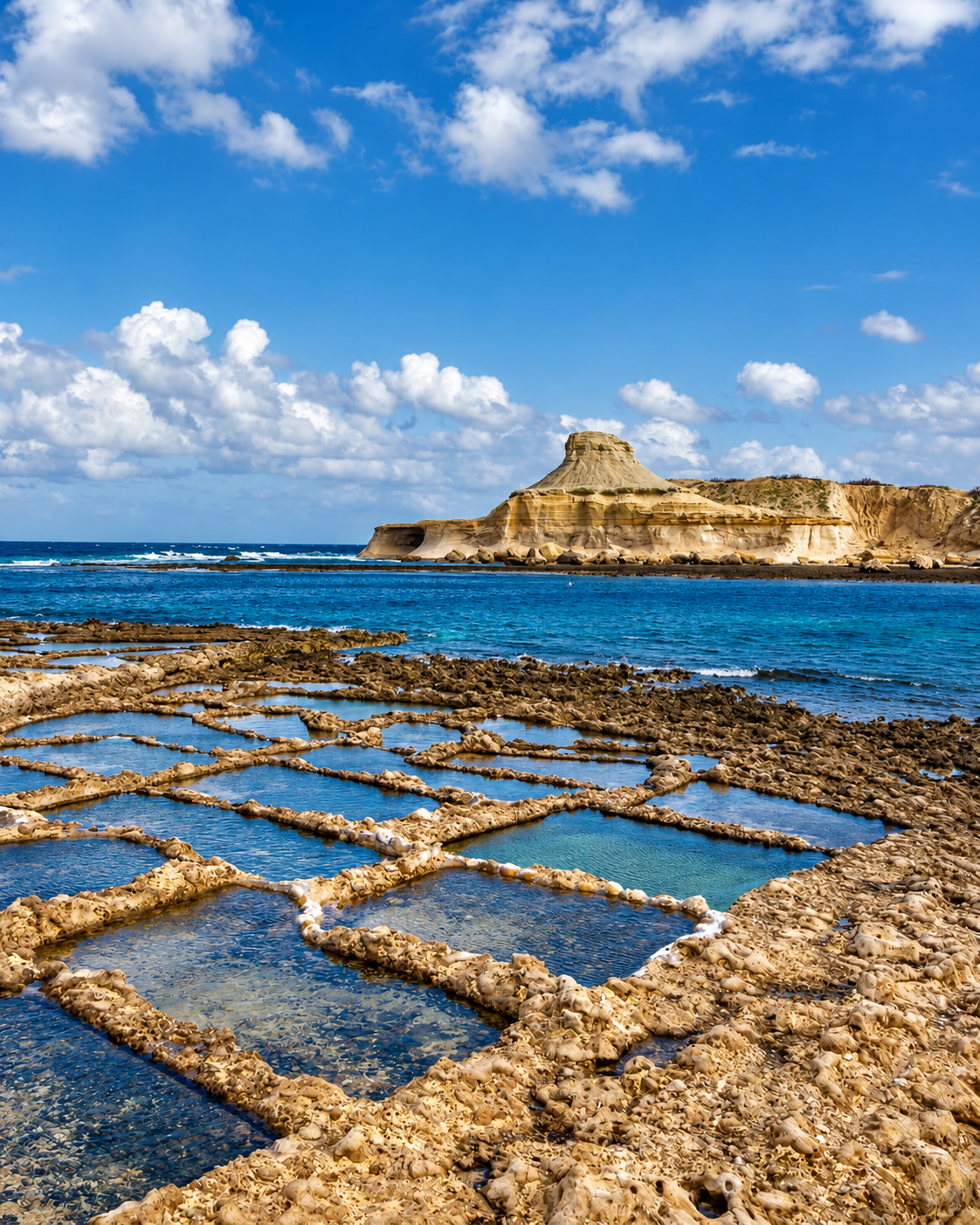
The salt pans of Marsalforn on Gozo’s northern coast are one of the most visually distinctive landscapes in the Maltese archipelago and one of its most revealing expressions of the relationship between human craft and natural environment. Carved directly into the coastal limestone over approximately three kilometres of shoreline, the pans form a grid of shallow rock-cut pools connected by narrow paths — a geometric pattern imposed on an irregular geology that creates, from a distance or from the air, one of the most striking examples of landscape pattern in the Mediterranean world.
The tradition of salt harvesting on this stretch of Gozo’s coast dates to Roman times. The process is essentially unchanged from its origins: seawater is channelled into the pans during spring and early summer, allowed to evaporate under the Mediterranean sun through the summer months, and the crystallised salt harvested by hand in late summer and early autumn. Many of the specific pans currently in use have been maintained by the same families for multiple generations, some continuously since the sixteenth century. This is not heritage performance — a traditional practice maintained for tourist consumption. It is a working salt harvest that produces a product sold locally, practised by people for whom the pans are an economic and cultural inheritance rather than a spectacle.
The visual character of the salt pans changes radically through the day and through the season. In the dry heat of summer, the salt crystallises white against the grey limestone, and the geometry of the pan grid is at its most legible — a pattern of light and shadow that produces the quality of abstract composition that aerial photography has made internationally familiar. At sunset, the shallow water that remains in the pans reflects the sky in a sequence of colours — the specific pinks and oranges of Mediterranean dusk — that transforms the geometric grid into something closer to landscape painting than to agricultural infrastructure. The salt pans also support a specific ecological community — the same principle that makes desert landscapes compelling to the considered traveller applies here: the apparent austerity of a natural environment reveals, to sustained attention, a complexity that more conventionally beautiful landscapes often do not provide. wading birds, marine invertebrates, and the halophytic (salt-tolerant) plant species that colonise the pan margins, contributing a biodiversity dimension that the landscape’s apparent austerity might seem to preclude — the same lesson available in any landscape that rewards sustained attention over rapid impression.
In the context of the broader slow luxury movement — the understanding that the most meaningful travel encounters are those that connect the visitor to authentic human processes rather than to produced experiences — the Gozo salt pans represent a paradigmatic case. The same intelligence that identifies handcraft as the highest expression of material culture recognises in the salt pans the equivalent in landscape terms: a place where the relationship between human skill, natural process, and geological time is visible in its simplest and most direct form.


Malta and the future — why the timeless endures
Condé Nast Traveller’s ongoing coverage of Malta reflects the broader editorial consensus that the archipelago’s unique concentration of cultural heritage and natural landscape makes it one of the Mediterranean’s most resilient luxury destinations. The trajectory of luxury travel — away from the novelty-driven, infrastructure-heavy, photogenic-destination model that has dominated the past two decades, and toward experiences defined by cultural depth, heritage authenticity, environmental integrity, and the specific quality of presence that only genuinely significant places produce — positions Malta with unusual structural advantage. The island does not need to manufacture authenticity, because it has preserved it. It does not need to invest in heritage experiences, because the heritage is the environment. It does not need to create a sense of historical depth, because the depth is geological — it is in the limestone itself, in the 7,000-year accumulation of human occupation that has shaped every surface of the island’s built environment.
The heritage tourism dimension is the most immediately legible. Valletta already receives visitors who come specifically for the Caravaggio, for the Baroque architecture, for the Grand Harbour — and the density of UNESCO-quality cultural heritage within the city’s one-kilometre length means that a serious cultural itinerary could occupy a week without exhausting the available depth. The slow travel dimension — the extension of stays, the commitment to specific places rather than the rapid consumption of multiple destinations — is naturally supported by an archipelago whose three main islands each require and reward different paces and different registers of attention.
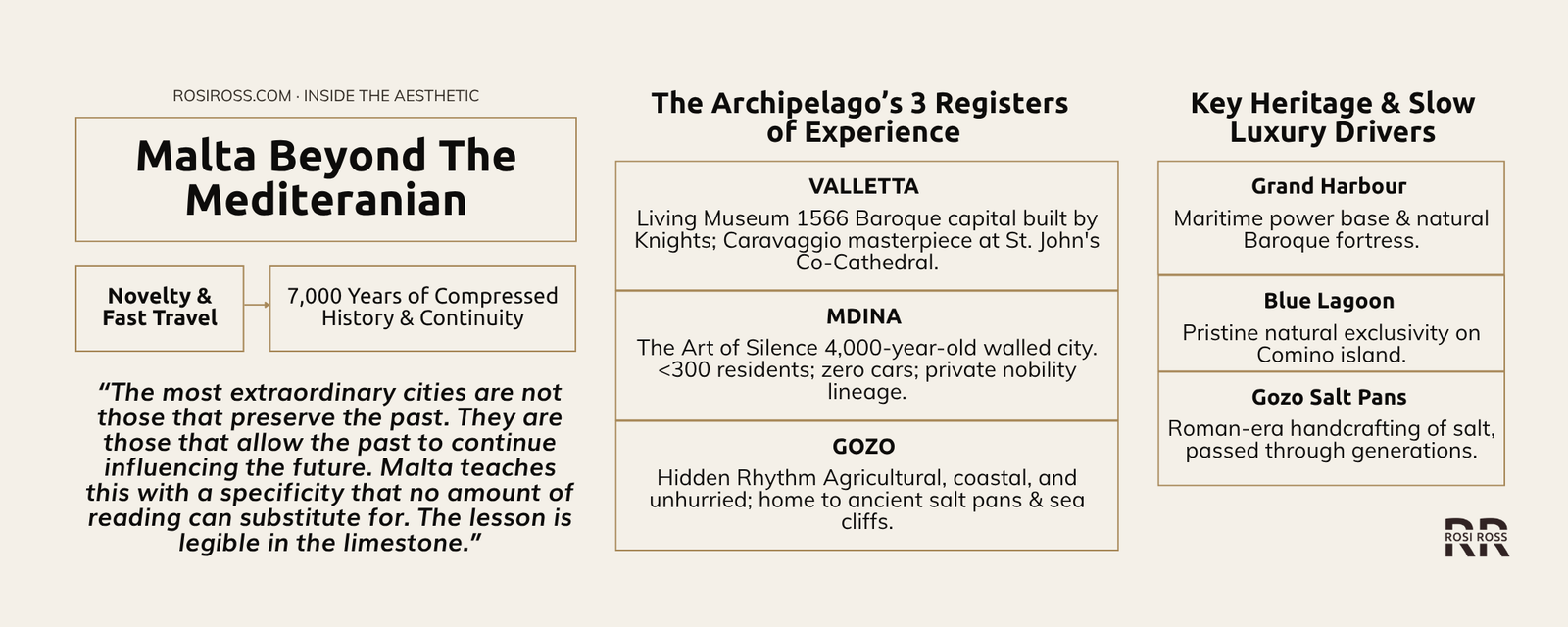
The wellness dimension of Malta’s appeal — the specific restorative quality of Mediterranean light, the coastal landscape’s effects on mood and physiological rhythm, the slower pace of island life — is increasingly recognised in the luxury travel literature as one of the most significant non-amenity factors in destination selection. The traveller who spends a week moving between Valletta’s cultural density, Mdina’s silence, Gozo’s agricultural rhythm, and the Blue Lagoon’s natural clarity is engaged in a form of environmental therapy that no resort or spa programme can fully replicate — because what it provides is not a treatment but an environment, and the environment is real. The finest luxury hospitality experiences understand that the most valuable thing they can offer is not an amenity but a context — and Malta’s context is four millennia of continuous civilisation compressed into 316 square kilometres of Mediterranean limestone.
Private experiences — the yacht through the Grand Harbour and Comino, the Michelin-starred dinner in a converted Valletta palazzo, the private guided access to St. John’s Co-Cathedral at a time when the oratory is otherwise closed — are the luxury layer that sits most naturally on top of Malta’s existing character. They do not substitute for the destination’s intrinsic qualities; they deepen the access to them. The most considered Malta itinerary is designed around exactly this principle: arriving slowly, staying longer than seems necessary, moving between the archipelago’s different registers of landscape and history at a pace that allows each place to communicate what it actually has to say.
Slow travel is a philosophy of travel that prioritises depth of experience over breadth of destination, longer stays over rapid transit between multiple locations, genuine cultural immersion over tourist consumption, and the development of real understanding about specific places over the accumulation of visited locations. Derived from the broader Slow movement — which originated in opposition to the fast-food industrialisation of Italian cuisine in the 1980s and subsequently extended to food production, design, work, and travel — slow travel proposes that the value of travel is located in the quality of attention brought to a place rather than in the number of places visited. For Malta, slow travel is not a reframing of an existing tourism product but the most accurate description of how the archipelago’s culture, history, and landscape are genuinely best experienced: Valletta requires multiple days, not hours; Mdina rewards the visitor who returns at different times of day; Gozo’s landscape and traditions become legible only over stays long enough to establish a rhythm; and the Blue Lagoon reveals its character to the visitor who arrives at the moment the light and the tide happen to coincide.
Contemporary luxury travel has undergone a structural redefinition that separates it fundamentally from the model of luxury as excess — as the most expensive hotel, the largest suite, the most elaborate amenity — that dominated the category through most of the twentieth century. The new definition of luxury in travel is organised around scarcity of a different kind: the scarcity of authentic cultural experience, of genuine historical depth, of natural environments uncompromised by mass development, and of the specific quality of presence that comes from being in a place that is genuinely significant rather than merely beautifully appointed. By these criteria, Malta is one of the most legitimately luxurious destinations in the Mediterranean: its cultural heritage is genuinely irreplaceable, its historical depth is genuinely extraordinary, its natural landscapes are genuinely distinctive, and its capacity to provide the specific quality of presence that significant places generate is not manufactured or staged but is simply the consequence of being what it has always been.
“Malta’s greatest luxury
is not found in what is newly built.
It is found in what has survived.
A fortified capital raised from limestone
in a single decade of ambition.
A silent city with a population of three hundred
and four thousand years of memory.
An island whose geology
has been shaping human settlement
since before recorded history began.
In an era where destinations compete
through novelty,
Malta offers something
that novelty cannot replicate:
permanence.
And permanence,
in the current travel landscape,
is the rarest luxury of all.”

