
On why the former Marine Police Headquarters is one of the most historically layered surviving Victorian compounds in East Asia, what it means to drink tea inside a designated monument that has operated continuously since the 1880s, how afternoon tea in Hong Kong absorbed colonial convention and made it into something the Duchess of Bedford would not entirely recognise, why the building changes the experience of the meal more completely than any ingredient on the tiered tray, and what House 1881 teaches us about the future of heritage travel
Canton Road runs through Tsim Sha Tsui with the particular commercial intensity that characterises Kowloon’s waterfront — luxury flagships, hotel lobbies, the compressed retail energy of one of the most commercially saturated corridors in Asia. Against this backdrop, the stone compound at the road’s southern end arrives as a complete temporal disruption: verandas and columns and Victorian proportions that belong to a different Hong Kong entirely, one that predates the towers and the neon and the contemporary skyline by more than a century. The former Marine Police Headquarters was completed in 1884. It has been watching Tsim Sha Tsui transform ever since.
This is the editorial context that makes the Café Parlour at House 1881 a more interesting proposition than its category — heritage afternoon tea — might initially suggest. The tea is carefully prepared, the seasonal menus are thoughtfully constructed, and the service carries the specific quality of attention that a well-run Hong Kong hospitality operation delivers as a matter of professional standard. But the experience of having afternoon tea in this particular room in this particular building is not primarily a gastronomic one. It is a spatial and historical one: the experience of occupying a designated monument, of sitting with a pot of Darjeeling in a compound where Marine Police officers worked and lived for over a century, of looking at stonework and columns that survived the Japanese occupation and watched Hong Kong transition from colonial territory to Special Administrative Region from the same vantage point on the Tsim Sha Tsui waterfront. The tea is the invitation. The building is the point.
The compound — what the former Marine Police Headquarters actually is
The former Marine Police Headquarters was constructed between 1881 and 1884 under the direction of the Public Works Department of the colonial government of Hong Kong — the completion date of 1884 giving House 1881 its contemporary name. The compound served as the operational headquarters of the Hong Kong Marine Police for over a century, with one notable interruption: the period of Japanese military occupation during the Second World War, when the compound’s function was, by necessity, otherwise directed. It continued as a Marine Police facility until 1996, when operational requirements moved the force to newer premises.
The site was declared a monument under the Antiquities and Monuments Ordinance in 1994 — two years before the Marine Police departed — a sequence that reflects Hong Kong’s approach to the most significant of its surviving Victorian-era structures: formal heritage protection secured while the building was still in operational use rather than after vacancy had allowed deterioration. The compound’s principal surviving structures include the Main Building (which houses the hotel and restaurant facilities including Café Parlour), the Stable Block, and the Signal Tower — the last of which served the practical function its name describes, communicating harbour conditions and navigational information to vessels operating in the waters of Victoria Harbour. The Hong Kong Antiquities and Monuments Office describes the former Marine Police Headquarters as one of the city’s oldest surviving government buildings — a characterisation that understates its significance: it is more precisely one of the most complete surviving examples of a Victorian-era Hong Kong government compound, a typology that has almost entirely disappeared from the contemporary urban landscape.
House 1881 is the contemporary hospitality and retail destination occupying the former Marine Police Headquarters compound in Tsim Sha Tsui, Kowloon, Hong Kong. The original compound was constructed between 1881 and 1884 by the Public Works Department of the colonial government. Its principal structures — the Main Building, the Stable Block, and the Signal Tower — served as the operational headquarters of the Hong Kong Marine Police from the 1880s until 1996, with the exception of the Japanese occupation period during the Second World War. The compound was declared a monument under the Antiquities and Monuments Ordinance in 1994, making it one of Hong Kong’s formally protected heritage sites. Its heritage value derives from several intersecting factors: it is among the city’s oldest surviving purpose-built government compounds; its Victorian neoclassical design language — verandas, symmetrical facades, stone construction, axial planning — represents a building tradition that has almost entirely disappeared from the contemporary Hong Kong urban landscape; and it occupies a historically significant waterfront position in Tsim Sha Tsui that has been continuously in institutional use for over a century. The site was subsequently developed as a heritage hospitality destination through a government-led adaptive reuse programme, a model that the Hong Kong government has applied to several of the city’s most significant surviving historic buildings.
What the building communicates — reading Victorian Hong Kong in stone
The formal language of the former Marine Police Headquarters is that of the British colonial administration’s preferred institutional building vocabulary in the late nineteenth century: neoclassical proportions applied to a tropical climate, with specific adaptations that distinguish it from its equivalents in Britain. The verandas — the covered external circulation corridors that run along the Main Building’s facades — are not a decorative gesture. They are a climatic response: the same functional logic that produced the veranda across the British colonial building tradition in India, Southeast Asia, and the Caribbean, providing shade from direct sun while allowing air movement through the building in the absence of mechanical cooling. The symmetry of the main facade communicates institutional authority in the visual grammar of the period: a building of the colonial government should read as permanent, ordered, and proportioned according to the civilisational values of the administering power. The stone construction — granite sourced locally, a material that gives the compound its specific warmth of colour and its resistance to the Hong Kong climate’s extremes — communicates durability in the most literal possible terms. This building was not designed to be temporary.
What the compound communicates to the contemporary visitor who looks at it with sufficient attention is a specific historical moment: the period in which Hong Kong’s colonial administration was establishing the institutional fabric — the police headquarters, the law courts, the government offices, the hospitals — through which it intended to govern the territory for an indefinite future. The Marine Police was a central institution in this fabric: the harbour was Hong Kong’s primary economic artery, and the policing of maritime traffic, the suppression of piracy, and the management of the extraordinary volume of vessels that passed through Victoria Harbour were among the administration’s most consequential operational responsibilities. The building’s scale and material quality reflect this institutional importance. The most revealing encounters with Hong Kong’s layered history are always those that direct the visitor’s attention not upward toward the contemporary skyline but outward toward the surviving fabric of a city that existed before it.


The adaptive reuse argument — why preservation through use matters
The most valuable acts of heritage preservation are those that maintain cultural practices in active use rather than archiving them behind glass — a principle that applies as much to built fabric as to living tradition. The question of what to do with a heritage building after its original institutional purpose has ended is one of the most consequential decisions in urban preservation practice — and Hong Kong has approached it with a consistency that distinguishes its heritage policy from that of many comparable cities. The former Marine Police Headquarters’ conversion into a heritage hospitality destination was not a simple commercial development. It was the product of a government-led adaptive reuse programme through which the site was granted to a developer on the condition that the compound’s heritage structures were restored and that the development maintained public access to the historic elements of the site. The model — preservation financed by commercial use rather than by public subsidy — has produced outcomes that museum-style preservation, which makes buildings accessible but not inhabitable, does not achieve.
The specific quality of the House 1881 experience that a museum conversion would have eliminated is the quality of occupation: the ability to sit in the historic spaces of the compound as a user rather than an observer, to drink tea in rooms that carry the material memory of their previous lives, to look out at Victoria Harbour from a building that has been doing exactly this since the 1880s. This is not a minor distinction. The gap between observing a historic space from the outside and occupying it — sitting in it, drinking in it, moving through its corridors and verandas — is the gap between historical knowledge and historical experience, and it is the gap that adaptive reuse, at its best, closes. The most consequential heritage propositions are those that find a way to make their history inhabitable rather than simply displayable — and House 1881’s conversion into a working hospitality destination is among the most successful available examples of this principle in the East Asian urban context.
Adaptive reuse in heritage conservation refers to the conversion of a building whose original purpose has ended to a new use that maintains the structure in active occupation while preserving its historically significant fabric. It differs from museum-style preservation (in which a building is maintained as a static exhibit) in that it generates the commercial revenue required to sustain ongoing maintenance and allows the public to experience historic spaces as users rather than observers. In Hong Kong, the government has applied adaptive reuse to several of the city’s most significant surviving historic structures under the Revitalising Historic Buildings Through Partnership Scheme and related programmes — with former industrial buildings, police stations, institutional compounds, and government premises converted into cultural centres, hospitality destinations, and community facilities. The former Marine Police Headquarters at Tsim Sha Tsui represents one of the earliest and most commercially successful of these conversions: the compound’s Main Building, Stable Block, and Signal Tower were restored and converted into the luxury hotel and dining destination now operating as House 1881, with the government’s conservation conditions ensuring that the heritage fabric of the buildings was maintained through the development process. The model is significant beyond its specific outcome because it demonstrates that heritage preservation and contemporary commercial viability are not inherently in conflict — that a well-designed adaptive reuse can produce a heritage destination that is simultaneously historically authentic, commercially sustainable, and publicly accessible.
Victorian neoclassical building in Hong Kong refers to the design vocabulary applied by the colonial Public Works Department to institutional buildings constructed during the later nineteenth and early twentieth centuries. Its characteristic elements include symmetrical facades governed by classical proportions, verandas and colonnaded galleries adapted from the British colonial building tradition in tropical climates, granite construction using locally quarried stone, pediments and pilasters referencing the formal grammar of Greek and Roman civic building, and axial site planning that communicated institutional authority through spatial organisation. The tradition produced Hong Kong’s most significant surviving historic buildings — including the former Marine Police Headquarters (1881–1884), the Old Supreme Court Building (now the Court of Final Appeal, completed 1912), the Former Central Police Station compound (now Tai Kwun, 1864–1919), and several colonial-era government premises — but very little else. Hong Kong’s extraordinary rate of urban redevelopment through the twentieth century, combined with the relatively limited heritage protection framework that governed demolition decisions for most of that period, meant that the great majority of Victorian-era institutional and domestic buildings were demolished to make way for the high-density development that now characterises the city. What survives is therefore not representative of what existed but an accidental or deliberately protected remnant of it — making each surviving example disproportionately significant as a record of the city’s pre-contemporary form.
The Café Parlour — afternoon tea as an act of cultural translation
Afternoon tea has a precise historical origin: the practice is credited to Anna Maria Russell, the seventh Duchess of Bedford, who in the 1840s introduced the custom of taking tea with light food in the afternoon as a social habit within the English aristocracy — addressing the long gap between the midday meal and the fashionably late dinner of the Victorian upper classes. The ritual spread rapidly through British society and, through the mechanisms of the Empire, across every territory where British administrative and social culture took root. Hong Kong was among the most thoroughgoing adopters of this cultural export: the colony’s British population brought the practice with them, the local Chinese population observed and in various degrees adopted it, and the commercial hospitality industry that developed to serve both populations created a specifically Hong Kong version of the ritual that was neither purely British nor a simple imitation of it.
The afternoon tea served at Café Parlour exists within this tradition of cultural translation. It is not attempting to reproduce the experience of a London or Edinburgh tearoom in a Hong Kong setting. It is something that could only exist in Hong Kong — a ritual whose form references its Victorian English origins while its content, its setting, its seasonal sensibility, and the specific quality of its hospitality reflect the place in which it is occurring. The seasonal rotation of the tea sets — with summer menus incorporating tropical fruits, the freshness of the local summer produce, unexpected flavour combinations that reflect contemporary Hong Kong’s cosmopolitan culinary culture — is not a departure from tradition but its most authentic expression: tradition maintained through adaptation rather than through static reproduction. The most enduring ritual dining experiences are those that understand what in the tradition is essential and what is contingent — and Café Parlour’s seasonal approach embodies this understanding: the ceremony of the tiered service, the unhurried pace, the quality of attention given to the table are all essential; the specific ingredients on any given tier are seasonal and therefore necessarily temporary.


The seasonal tea — why the menu is ephemeral and the ritual is not
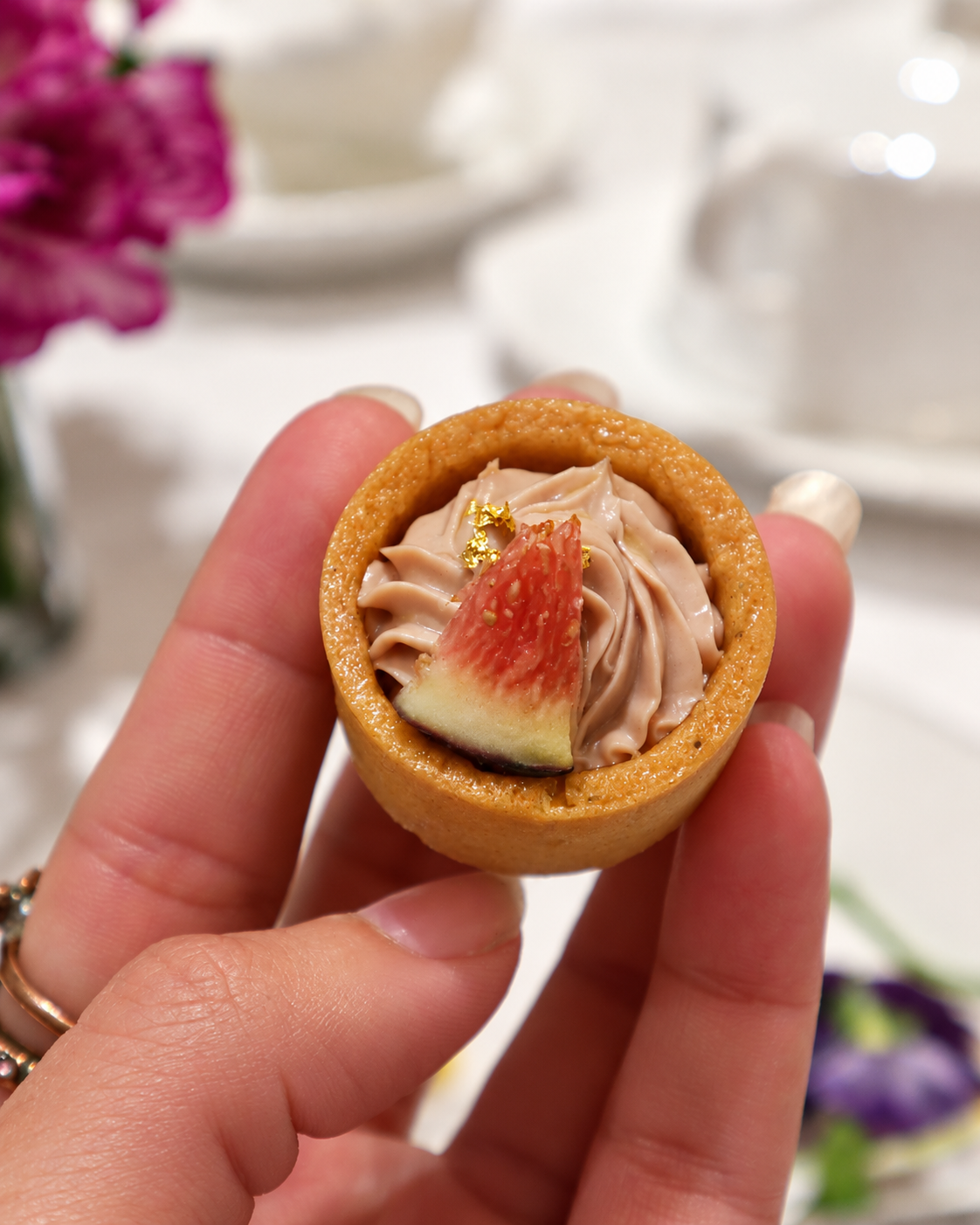
The Café Parlour’s rotating seasonal tea sets represent one of the more intelligent decisions in its programming: by tying the menu to the season rather than establishing a permanent offering, the kitchen creates a genuine reason to return across the year while simultaneously encoding into the tea service the same respect for seasonal ingredients that the most considered culinary traditions have always prioritised. A summer afternoon tea at Café Parlour incorporates the flavours of the season — the tropical fruits, the lighter preparations, the specific balance of sweet and savoury that the heat of Hong Kong’s summer suggests — in a way that a static menu cannot. The culinary creativity this demands — finding ways to bring grilled watermelon alongside Parma ham, to introduce the freshness of summer berries into pastry work that respects the format’s traditional register — is the kind of seasonal thinking that distinguishes an engaged kitchen from a merely competent one.
The specific elements of any particular seasonal set will change. The salmon sandwiches of one summer will give way to the preparations of the next. The gold accents and seasonal fruit arrangements are expressions of the moment rather than permanent fixtures of the experience. The visitor who focuses primarily on documenting the current season’s tiered arrangement is looking at the surface of the experience rather than its substance. What remains constant across every season is the quality of the setting — the stone compound outside, the Victorian details within, the specific quality of light that enters the Café Parlour’s windows in the mid-afternoon, the unhurried pace that the building’s scale and character seems to impose on everyone who enters it. The meal is seasonal. The building is permanent. And the building, as this article has attempted to demonstrate, is the more important variable in the equation. The most enduring travel encounters are those that take place in environments with enough historical density to shape the experience of being in them — and few dining environments in Hong Kong carry the specific historical weight of a room inside a designated monument that has been continuously occupied since the Victorian era.


The ritual of the table — how afternoon tea operates as a social form
Afternoon tea is among the most specifically social of all dining formats — not in the sense that all meals are social occasions, but in the more precise sense that the form itself is designed around social interaction in a way that other meal formats are not. The three-tiered service — savouries below, scones in the middle, sweets above — creates a shared object at the centre of the table around which conversation can organise itself, a structure that regulates the pace of the meal without imposing the formality of a set-course service. The tea itself provides the constant: pot replenished, cup attended to, the liquid that anchors the social dynamic of the gathering and provides its continuous thread. The pace of an afternoon tea is slower than that of a conventional lunch — not because anything prevents it from proceeding quickly, but because the format creates no pressure to do so. It is, in this sense, one of the rare dining formats whose primary offering is time: permission to occupy a pleasant room, in pleasant company, for longer than efficiency would require.
The etiquette that surrounds afternoon tea — the convention of breaking rather than cutting scones, the stirring motion that avoids clinking the cup’s sides, the matter of the pinkie finger (correctly kept down, not extended, whatever the popular mythology suggests) — is less a set of rules than a shared grammar that allows participants to navigate the social occasion with confidence. The most important of these conventions is not any specific gesture but the underlying orientation they collectively express: that this is an occasion worth attending to with some degree of care, that the quality of the company and the quality of the attention paid to the experience are more significant than the volume of food consumed or the speed at which the afternoon passes. Knowledge of the conventions is valuable not because breaking them is catastrophically wrong but because possessing them frees the visitor to pay attention to what actually matters — the building, the company, the tea, and the specific pleasure of occupying a Victorian-era monument on the Tsim Sha Tsui waterfront for two unhurried hours on an afternoon in Hong Kong.
Afternoon tea was introduced to Hong Kong through the British colonial administration and the social practices of the colony’s British population, who maintained the custom as part of the broader cultural life of the colonial community from the nineteenth century onward. The practice subsequently spread into the Chinese Hong Kong population and the commercial hospitality industry through a process of cultural adoption and adaptation that produced a specifically Hong Kong version of the ritual — one that maintained the format’s basic structure (tiered service, fine china, a selection of savouries and sweets, tea as the primary beverage) while incorporating local ingredients, sensibilities, and culinary traditions. Hong Kong’s position as one of Asia’s foremost luxury hospitality centres has made the afternoon tea a commercially significant offering across the city’s luxury hotels and heritage venues, with properties competing not only on the quality of the food and tea but on the distinction of the setting. In this context, Café Parlour at House 1881 occupies a specific position that no newer property can replicate: its setting within a designated monument gives it a historical dimension that the finest contemporary hotel interior cannot manufacture. The afternoon tea tradition in Hong Kong is therefore no longer a colonial inheritance maintained through convention but a genuinely local cultural form — one that absorbed its British origin and transformed it into something that could only have developed in the specific social and cultural context of Hong Kong.

The case for experiencing Hong Kong through its surviving buildings
The cities that reward the most serious attention are invariably those whose historical layers have survived long enough to be legible to the visitor prepared to look for them. Hong Kong is most frequently understood through its contemporary visual language — the density of the vertical city, the harbour at night, the commercial energy of its retail districts, the extraordinary concentration of global luxury brands in a relatively small geographic area. This is a legitimate understanding of a city that has genuinely earned its reputation as one of the world’s most commercially and visually remarkable urban environments. But it is an incomplete understanding, because it reads the city’s most visible layer without attending to the layers beneath it — the surviving fragments of the Victorian-era institutional city, the pre-war tenement buildings of the older residential districts, the temples and markets and neighbourhood commercial streets that carry the social and commercial memory of a Hong Kong that predates the contemporary skyline by several generations.
The value of House 1881 for the culturally motivated traveller is precisely this: it provides access to one of Hong Kong’s most significant surviving historical layers in a context that does not require the visitor to adopt the stance of a museum-goer. The visitor comes to have tea and ends up inside a monument. The monument turns out to be more interesting than the tea. The tea turns out to be better for being consumed inside the monument. The experience is circular in the way that the best heritage travel experiences always are: the destination provides context for the activity, the activity provides occasion for inhabiting the destination, and the combination produces an understanding of place that neither alone could generate. The future of luxury travel may belong less to the newest properties than to those whose value is most directly determined by where they are and what surrounds them — and in Hong Kong, few properties sit within a richer, more specifically irreproducible historical context than this stone compound on the edge of Victoria Harbour, where the Marine Police operated from the 1880s and where afternoon tea is now served to visitors who may or may not know that they are sitting inside one of the city’s most consequential surviving acts of Victorian institutional building. It is worth knowing. The most valuable travel experiences in Hong Kong are those that teach the visitor how to read the city rather than simply how to consume it — and Café Parlour at House 1881 is, among the city’s heritage hospitality destinations, one of the most complete available lessons in this specific kind of reading.
“The menu changes with the season.
The china is replaced when it chips.
The city outside continues to transform
at the particular velocity
that Hong Kong has always preferred.
The stone compound remains.
And that is precisely why
the experience of having tea within it
has editorial value
that no amount of culinary refinement
in a newly opened room
can manufacture.
Heritage is not nostalgia.
It is the specific weight
of a place that has continued
to mean something
across the full length
of its own history.”