
On why Mykonos is not a destination that competes through spectacle but one that wins through atmosphere, how Cycladic design — whitewash, rounded walls, the specific blue of the Aegean reflected in every painted shutter — became one of the most globally influential aesthetic systems produced by any vernacular building tradition, what the windmills overlooking the sea communicate about the relationship between wind and island life across five centuries, why the sunset at Scorpios is one of the most precisely designed emotional experiences available in the Mediterranean, and what Mykonos teaches the world about the difference between luxury created by accumulation and luxury created by presence
There is a moment on Mykonos, usually somewhere between four and six in the afternoon depending on the season, when the light begins to do what Aegean light does: it flattens and warms simultaneously, pulling colour from the whitewashed walls in a way that makes them appear to generate their own luminescence rather than simply reflect the sun. The wind is almost always present — the island is named for it, was shaped by it, built around it — and at this hour it carries the specific quality of late afternoon warmth that the Mediterranean reserves for its most golden days. This is the moment Mykonos has been perfecting for centuries, long before the first luxury hotel arrived, long before the beach clubs, long before the international crowd that discovered the island and decided, with the reliable instinct of people who recognise something genuine, that it was worth the journey.
Mykonos is unusual among the world’s great luxury destinations because its visual identity — the one that made it globally recognisable and kept it globally relevant across decades of tourism that should theoretically have standardised it — was not designed. It was necessary. The whitewash was applied to reflect the intensity of the Cycladic sun and reduce interior heat, not to create a photographic backdrop. The blue of the doors and shutters references the Aegean Sea that surrounds the island on every side, not a colour palette agreed in a design meeting. The windmills were functional grain-processing facilities, not landmarks. The narrow streets of Mykonos Town were made winding and irregular to break the force of the seasonal north winds, not to create an atmospheric labyrinth for visitors to discover. Every element of the island’s visual identity began as a response to the specific environmental conditions of life in the Cyclades — and in that origin, rather than in any subsequent decision to market it, lies the reason it has proven so durable. You cannot replicate necessity. You can only discover it.
Mythology and the island’s ancient identity — what Mykonos was before it was famous
The island’s place in Greek mythology predates its tourism identity by several millennia. According to ancient tradition, Mykonos was formed from the petrified bodies of giants killed by Hercules in the legendary battle that mythology places in this part of the Aegean — the island’s rocky, wind-scoured landscape lending itself naturally to the idea of something transformed from living conflict into permanent stone. The island takes its name from Mykonos, described in ancient sources as a local hero, traditionally identified as a grandson of Apollo and the first ruler of the island’s settled community. The Apollonian connection is significant: Apollo was the god of light, of clarity, of the sun’s rational illumination of the world — and there is something in the quality of light that Mykonos produces, particularly in the long afternoon hours before sunset, that makes this mythological lineage feel less like historical footnote and more like persistent condition.
What mythology gives Mykonos that tourism cannot manufacture is depth: the sense that the island has been important for longer than anyone currently visiting it can fully comprehend, that the Aegean it sits within has been crossed and re-crossed by sailors, traders, warriors, and wanderers across a span of human history that makes the contemporary luxury traveller’s arrival a small and very recent event in a very long story. This depth is part of what the most serious luxury travel consumer is actually purchasing when they choose Mykonos over a newer, equally beautiful, more easily accessible destination. They are purchasing the specific quality of atmosphere that only genuine historical layering produces — the feeling that the place existed, and mattered, and meant something, before they arrived. The most enduring luxury destinations in the Mediterranean are those whose cultural identity predates their discovery by tourism by sufficient distance that the two can coexist without the latter consuming the former.
What is the mythology and historical significance of Mykonos — and why does ancient identity matter for a contemporary luxury destination?
Mykonos is one of the Cycladic Islands of the southern Aegean Sea, part of the Greek archipelago whose settled history extends to the third millennium BCE. In Greek mythology, the island is associated with the battle between Hercules and the Giants, with the island traditionally understood as formed from the petrified bodies of the defeated giants — an origin story that connects the island’s rocky, wind-exposed landscape to the physical evidence of divine conflict. The island’s name derives from Mykonos, a local hero described in ancient sources as a descendant of Apollo, the god of light and the sun, and traditionally identified as the first ruler of the island’s settled community. The island was inhabited during the Bronze Age and played a role in the maritime trade networks of the ancient Aegean. Its contemporary identity as a luxury destination is inseparable from this historical depth: the same Cycladic landscape, the same quality of Aegean light, the same relationship between the island and the north winds that shaped its agricultural economy and gave it its nickname “The Island of the Winds” have persisted across the full span of human occupation. The luxury of Mykonos is therefore not separable from its antiquity — it is, in part, the specific atmospheric quality that only a place with this degree of historical layering can produce.
Cycladic design — why necessity became the world’s most influential vernacular aesthetic
Cycladic building tradition — the whitewashed cubic forms, the rounded corners, the minimal openings, the flat or slightly domed roofs, the blue accents of doors and shutters and domes — is now recognised globally as one of the most influential vernacular aesthetic systems ever produced. Its influence runs through twentieth-century modernism, through the work of Le Corbusier and the Bauhaus’s engagement with Mediterranean building, through the wellness resort design of the current generation, through the interior language of luxury hospitality from the Greek islands to California. This is a remarkable cultural trajectory for a building tradition that began as a purely functional response to the specific environmental demands of Cycladic island life.
The whitewash reflects the intense solar radiation of the Greek summer, reducing interior temperatures in an era before mechanical cooling. The thick walls — typically sixty to eighty centimetres of stone — provide thermal mass that absorbs heat during the day and releases it slowly at night, moderating interior temperature without any active energy input. The small, deep-set windows minimise heat gain while providing ventilation. The rounded corners reduce wind resistance — important in an environment where the seasonal north winds, the Meltemi, reach sustained speeds that would exploit every exposed angle. The blue of the doors and shutters: the traditional explanation is that the blue pigment, cheaply produced from limestone and copper, functioned as a deterrent to insects, but the colour’s persistence owes more to its resonance with the Aegean Sea that surrounds the island than to any purely practical argument. The most enduring design languages are always those that began as responses to specific environmental conditions and accumulated cultural meaning through the centuries of consistent application that followed — and Cycladic building is among the most complete examples of this process available in any vernacular tradition.


The windmills — five centuries of wind and what it built
The windmills of Mykonos are among the most photographed landmarks in the Mediterranean, which makes it easy to forget what they actually are: working grain mills, built predominantly in the sixteenth century by the Venetian rulers of the Cyclades, powered by the same north winds that shaped the island’s building tradition and gave it its ancient nickname. Their position on the elevated ridge overlooking the harbour and the sea was not chosen for its photographic quality — it was chosen because this location maximised exposure to the Meltemi, the seasonal north wind whose reliable presence between June and September made it the primary power source available to an island economy dependent on grain processing. The mills ground grain carried to Mykonos by the maritime trade that was the island’s primary economic activity for centuries, and their number — at their peak, Mykonos had dozens of working mills — reflects the volume of that trade.
The most famous cluster, known as Kato Mili — the lower mills — stands on the ridge above the harbour with a directness and a simplicity that is characteristic of functional Cycladic building at its most resolved: circular stone towers, conical thatched or slate roofs designed to rotate into the wind, the whole composition offering the wind resistance of a rounded form rather than the vulnerability of an angular one. Boni’s Windmill, positioned higher above Mykonos Town, is now a folklore museum and offers one of the island’s most complete available views: the town below, the harbour, Little Venice extending into the sea, and the Aegean horizon beyond. What the windmills communicate to the visitor who looks at them with sufficient attention is not nostalgia — it is continuity. The wind that powered the mills is still present. The landscape they were built to serve is still recognisable. The five hundred years between their construction and the contemporary visitor’s arrival are less a distance than a depth — and that depth is, in the most precise sense, what Mykonos is made of. The most significant landmarks are those that communicate something about the conditions that produced them rather than simply providing a surface for aesthetic appreciation.
Little Venice — where the island meets the sea in its most dramatic register
Little Venice — the Alefkántra quarter of Mykonos Town — is the island’s most cinematically immediate neighbourhood: a row of houses and former merchant residences built directly on the waterfront, their foundations in the sea, their facades presenting to the Aegean a sequence of coloured balconies and shuttered windows whose reflection in the water below creates the doubled image that gave the neighbourhood its borrowed name. The comparison with Venice is inexact — these are not canal-side buildings but sea-side ones, and the water beneath them is the open Aegean rather than a navigable interior waterway — but the essential quality that the name identifies is accurate: an urban fabric in unusually direct relationship with a body of water, the boundary between the built and the aquatic less fixed than urban convention normally permits.
The neighbourhood’s history is maritime and mercantile: it was built primarily in the eighteenth century by the wealthy sea captains and merchants who controlled the island’s trade, and the small doors visible at sea level — too low for comfortable entry, positioned at the waterline — have accumulated a folklore of piracy and secret storage that the island’s reputation as a trading post and maritime crossroads makes more plausible than fanciful. These basement-level doors, now mostly converted into the entrances of bars and small restaurants, once provided direct water access to the buildings above them — a practical feature of a maritime merchant’s residence that history and popular imagination have subsequently reframed as something more dramatic. The best time to reach Little Venice is around four in the afternoon, before the sunset crowd arrives and while the light on the water still carries the quality of the Aegean afternoon rather than the compressed intensity of the golden hour. Stay through the transition: what the neighbourhood does at sunset — the light moving across the water, the facades deepening from white to rose to amber — is one of the most uncontrived visual sequences available in the Mediterranean. The places that reward patience in Greece are always those that have been shaped by centuries of life at the intersection of land and sea.


What is Cycladic design — and why has the vernacular building tradition of the Greek islands become one of the most globally influential aesthetic systems in contemporary design?
Cycladic design refers to the vernacular building tradition of the Cycladic Islands of the southern Aegean Sea — most prominently Mykonos, Santorini, Paros, and Naxos — characterised by whitewashed cubic forms, rounded or bevelled corners, minimal window openings, flat or slightly domed roofs, and the consistent use of blue, terracotta, or ochre for doors, shutters, and dome accents. The tradition developed as a direct functional response to the specific environmental conditions of Cycladic island life: intense summer solar radiation requiring maximum light reflection from exterior surfaces, strong seasonal winds (the Meltemi) requiring rounded forms that minimise wind resistance, limited building materials requiring the use of local limestone, and an island climate requiring thermal mass sufficient to moderate interior temperatures without mechanical cooling. The tradition’s global influence derives from the specific combination of formal qualities it produces — geometric simplicity, material honesty, the relationship between white surfaces and blue sky and sea — that anticipated the formal principles of twentieth-century modernism by several centuries. Le Corbusier’s documented engagement with Mediterranean vernacular building, the Bauhaus’ interest in functional form, and the subsequent development of the “Mediterranean minimalism” aesthetic in luxury hospitality, wellness design, and contemporary interior design all reflect the ongoing cultural authority of a building tradition whose formal qualities emerged from necessity rather than theory.
The Meltemi (Greek: Μελτέμι), also known as the Etesian winds, is the dominant seasonal wind system of the Aegean Sea, blowing from the north and northeast with sustained force across the Cycladic Islands from approximately June to September. It is generated by the pressure difference between the continental high-pressure system over the Balkans and the thermal low that develops over Turkey and the eastern Mediterranean during summer months. On Mykonos, the Meltemi is a defining environmental presence: it was this wind that powered the island’s grain mills, positioned at ridge elevations maximising exposure to the north wind; it is this wind that shaped the winding, narrow street plan of Mykonos Town, designed to break the force of the wind through irregular urban geometry rather than allowing it to build speed through straight corridors; it is this wind that influenced the rounded corners and minimal exposed surfaces of Cycladic building; and it is this wind that the island’s sailors depended on for the consistent northerly movement that made the Aegean maritime trade routes navigable. The same wind that complicated summer swimming and made outdoor dining adventurous on gusty days also kept the island cool during the intense Aegean summer and maintained the specific quality of Aegean clarity — the absence of humidity and haze that makes Mykonos light so distinctive — that has attracted painters, photographers, and travellers for centuries.
Scorpios — when a beach club becomes an emotional proposition
Scorpios Mykonos is the most sophisticated available case study in what happens when hospitality designers stop asking “what can guests consume here?” and begin asking “how do guests feel when they are here?” — a shift in the animating question of hospitality that represents the most significant development in luxury beach culture since the beach club first emerged as a distinct category in the Mediterranean in the mid-twentieth century. The property’s visual language — natural materials, organic forms, the specific quality of shade and light that its outdoor spaces produce — communicates its philosophy before any activity has taken place: this is an environment that intends to make you feel something rather than simply provide you with something.
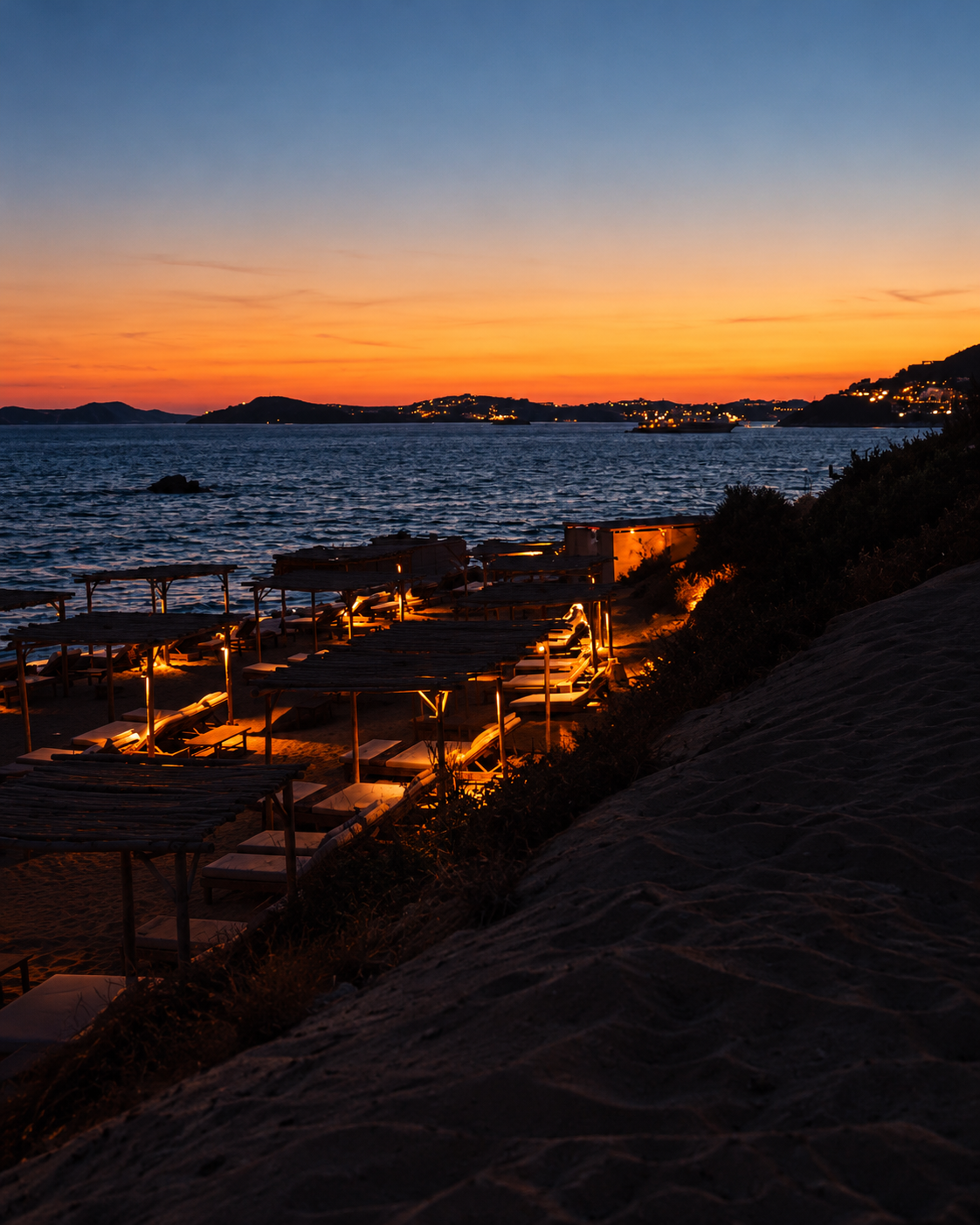
The sunset ritual at Scorpios is the most famous expression of this philosophy and is worth understanding as a designed experience rather than as a fortunate coincidence of location and timing. As the sun approaches the horizon, live violin performs with an intention that builds across the final minutes of the descent — a musical programme calibrated to the specific emotional register of collective sunset-watching, which is something distinct from any other social experience: the gathering of strangers around a shared natural event that is simultaneously entirely predictable (the sun will set at a known time) and entirely unrepeatable (this particular quality of light, on this particular evening, will not occur again). The music’s role is to mark this unrepeatable moment as significant — to create the formal container within which the experience can be fully felt rather than simply observed. The design thinking behind this is considerable: Scorpios has understood that the most powerful luxury experiences are not those that provide the rarest access to rare things but those that make ordinary things — a sunset, a piece of music, a glass of wine, the company of strangers sharing a view — feel as significant as they actually are. The most enduring beach club propositions are those that understand their primary offering is not a location but an atmosphere — and Scorpios has built one of the most precisely considered atmospheres available at any price point in the Mediterranean.


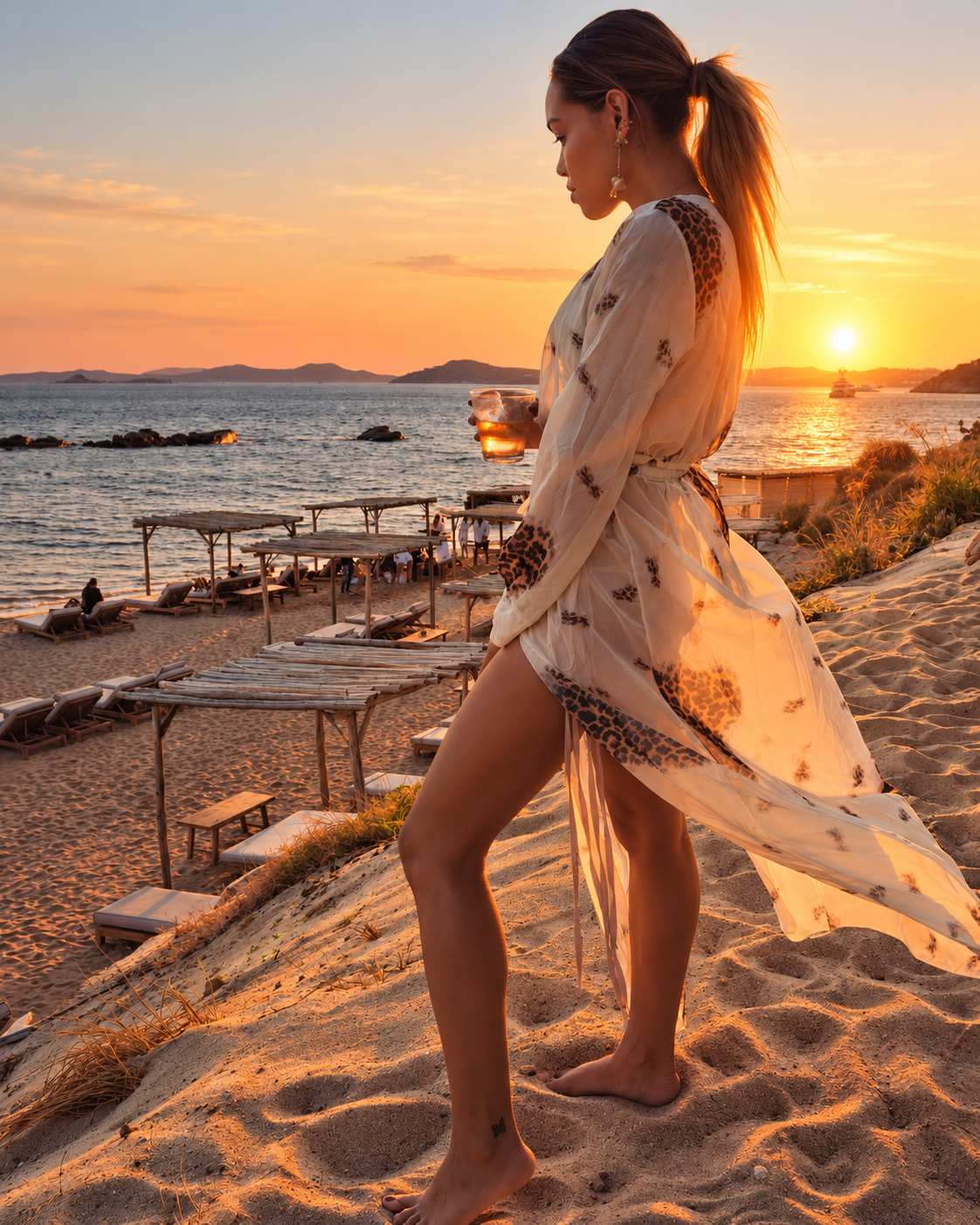
180 Sunset Bar — the luxury of the journey and the reward of arrival
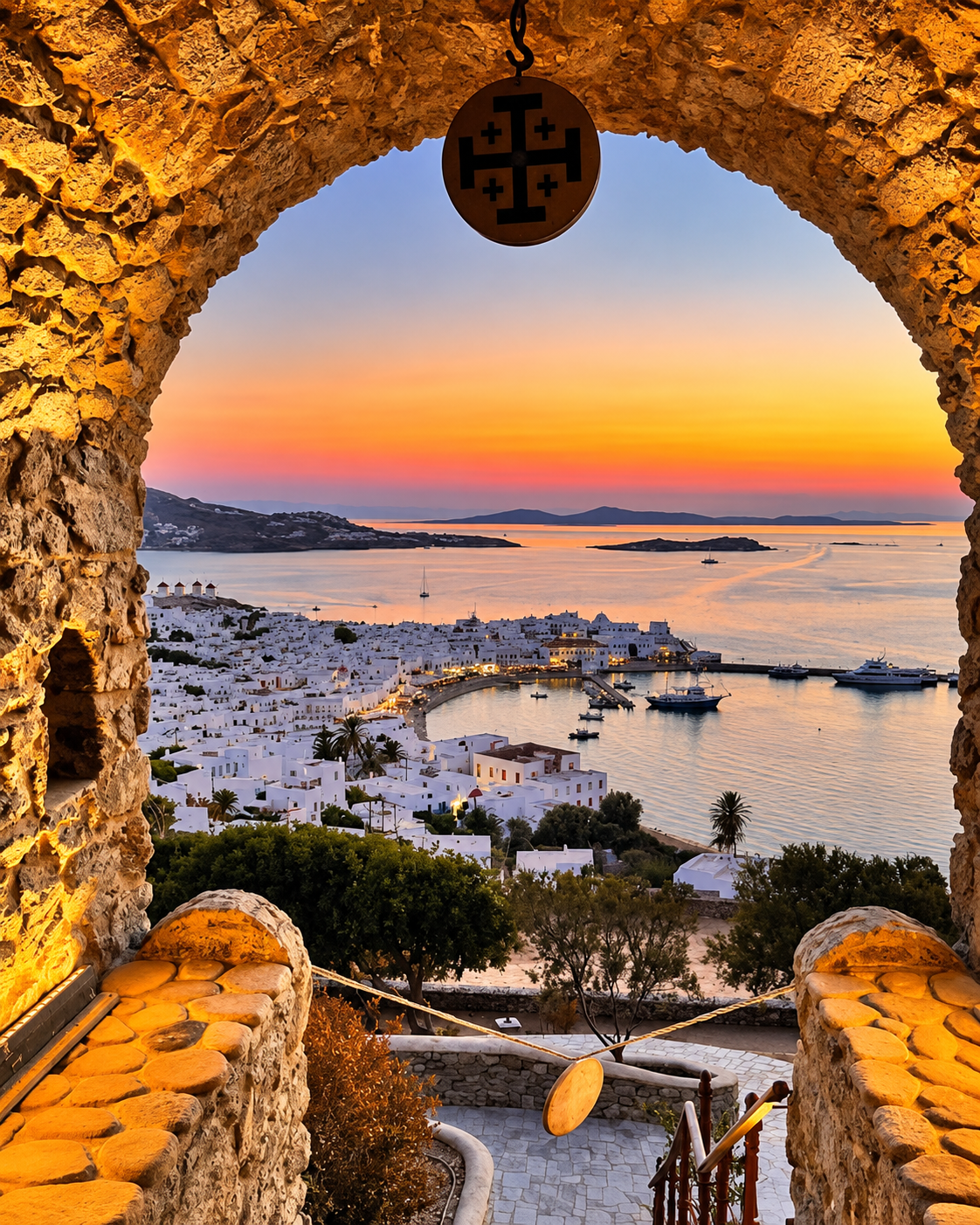
The 180 Sunset Bar, set within the Mykonos Castle Panigirakis above Mykonos Town, makes its most important design decision before the guest enters it: the bar is accessible on foot by a walk up steep, narrow, winding paths through the old town — roads not designed for comfortable ascent, whose gradient and surface and direction were determined by the same logic that determined the rest of Mykonos Town’s winding layout, namely the need to break the force of the north wind through the urban fabric. The walk is not convenient. It is also not optional, for anyone who takes the pedestrian route — and the walk’s inconvenience is, in the most specific sense, part of the product. A view that has been arrived at through effort communicates differently from a view accessible by elevator or vehicle. The body’s experience of climbing through the town — the narrow passages, the occasional glimpse of sea between buildings, the sound of the wind increasing as the path rises — creates a physical anticipation that the panorama at the top then resolves. This is arrival as a designed experience, not a logistical necessity.
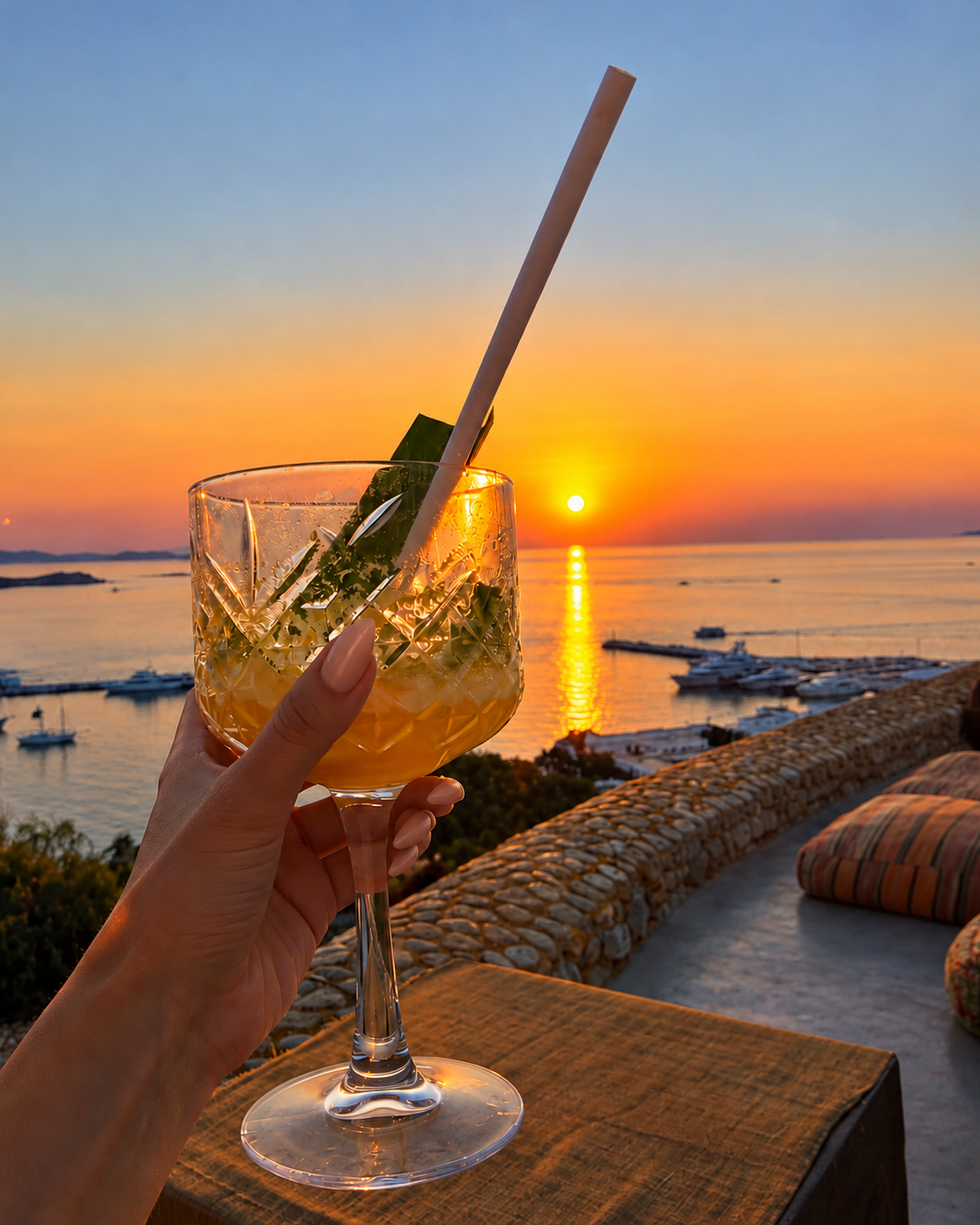
The panorama from the bar’s elevated position is among the most complete available on the island: Mykonos Town below, the line of windmills on the ridge, the harbour with its boats, Little Venice’s waterfront edge, and the Aegean extending to the horizon in every direction from which the island’s elevated centre is not blocking the view. The bar’s seating — sofas and chairs integrated with the ancient stonework of the castle, the built and the natural so continuous that it is not always clear where one ends and the other begins — creates an environment whose primary luxury is not its cocktail list (although the Greek and international wine selection and champagne menu are thoughtfully composed) but its relationship to the view. Arrive before sunset. Secure a seat. Allow the afternoon to become evening at the pace the island itself suggests. The highest form of hospitality is always the one that uses the specific qualities of its physical setting to shape the emotional experience of being present in it — and the 180 Sunset Bar achieves this through the simplest possible means: a hilltop, a view, and sufficient restraint to let both do the work.



Mykonos maintains its cultural authority as a luxury destination through a specific combination of qualities that newer and more expensively developed destinations struggle to replicate: genuine historical depth, a vernacular visual identity that cannot be manufactured from scratch, an environmental character (the Aegean light, the Meltemi winds, the specific quality of the island’s landscape) that is inseparable from the experience of being there, and a hospitality culture that has evolved from the island’s existing social and cultural life rather than being imposed upon it. These qualities distinguish Mykonos from destinations whose luxury identity was created through capital investment alone. The island’s formula — ancient mythology and history, Cycladic visual language, the Mediterranean social rhythms of long meals and outdoor living and collective sunset-watching, contemporary hospitality of genuinely high quality — is one that cannot be replicated because each element is specific to the island’s physical and cultural geography. As luxury travel preferences have evolved from an orientation toward the most expensive and exclusive toward an orientation toward the most atmospheric and authentic, Mykonos has benefited rather than suffered from this shift: its most durable attractions are precisely those that were always present, always free, and always inseparable from the specific quality of life that the island produces.
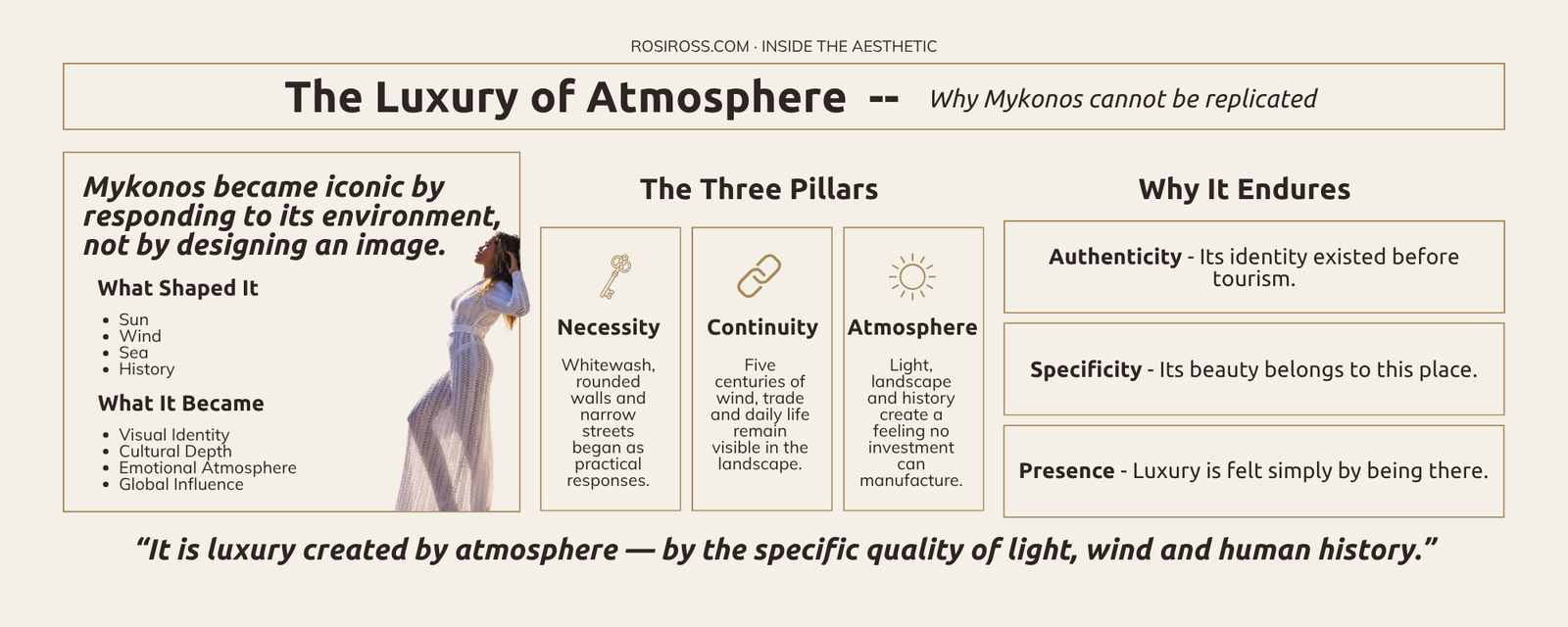
Why Mykonos remains timeless — the luxury of atmosphere over accumulation
The contemporary luxury travel market is characterised by a paradox that Mykonos navigates with unusual ease: the more elaborately designed and expensively equipped a destination becomes, the more quickly it risks becoming dated — because the specific design language and hospitality innovations that defined it at the moment of its peak will eventually be surpassed by whatever comes next. The destination that competes through the luxury of the individual property, the exclusivity of the access it provides, or the novelty of the experience it offers is always vulnerable to the next property, the next access, the next novelty. Mykonos is not immune to this dynamic — it has experienced seasons in which its association with a particular social crowd or a particular party culture has risked reducing it to a trend — but its deepest qualities are consistently more durable than whatever is currently in fashion at its beach clubs.
The whitewash, the blue, the wind, the light, the windmills, the harbour, the mythology, the specific quality of the Aegean afternoon — none of these is vulnerable to the next trend in luxury hospitality because none of them is the product of luxury hospitality. They are the product of five thousand years of human life in a specific place with specific environmental conditions and specific cultural traditions. The traveller who comes to Mykonos for the parties and the exclusivity and the social visibility may find that these things are differently configured on their next visit than on their last. The traveller who comes for the atmosphere — for the particular quality of being on a Cycladic island at the edge of the Aegean, in the late afternoon light, with the north wind moving through streets that were built to manage exactly this wind — will find that the atmosphere is exactly as it was. Luxury, when it is produced by atmosphere rather than by accumulation, does not date. It deepens. And Mykonos, at its best, has always understood this. The most significant Mediterranean destinations are those whose value is most directly a function of what they have always been — of the specific intersection of landscape, light, and human history that no amount of investment can manufacture and that time, rather than diminishing, only makes more specific.
“Mykonos is not luxury
created by excess.
It is luxury created by atmosphere —
by the specific quality of light
at four in the afternoon,
by the wind that shaped
every building on the island,
by the five thousand years
of human life in this particular place
that make the sunset
feel like something
worth stopping for.
The island’s greatest offering
is not what it provides.
It is how it makes you feel
simply by being present in it.”

