
On why Ariana Grande’s cat-eye is not eyeliner but geometry — and what that distinction reveals about makeup as a visual language, how a wing creates the perception of lift through the specific physics of line direction and contrast, what Rina Kozyreva’s childhood in Vladivostok and her mother’s red lipstick have to do with the professional discipline of fashion makeup, why Russian makeup artistry occupies a particular position in the global beauty landscape that sits between meticulous precision and creative experimentation, and why the most important thing the Ariana Grande look can teach is not how to replicate it but how to understand what it is doing
The most sophisticated approaches to beauty always begin with the underlying principle rather than the surface instruction. Consider the wing. Not as a fashion choice or a celebrity reference but as a formal decision: a line beginning at the outer corner of the eye, travelling upward at a precisely chosen angle, creating a shape that exists nowhere on the face anatomically but that the eye reads as structural. The wing does not lengthen the eye. It creates the visual suggestion of length through the specific relationship between the line and the lid beneath it. It does not lift the eye. It creates the impression of lift through the direction of its travel. It does not add colour. It adds contrast — the darkness of the line against the skin making the white of the eye appear larger, the iris more luminous, the entire orbital area more three-dimensional than the tools involved would suggest possible. This is not a beauty trick. It is applied visual design. And understanding how it works — the principles behind the geometry rather than the specific steps to replicate a specific look — is the difference between makeup applied by someone following instructions and makeup applied by someone who understands what they are doing.
Ariana Grande’s beauty signature is the most recognisable application of these principles in contemporary popular culture: the elongated wing, the softly sculpted cheekbones, the defined brow, the nude lip that deliberately restrains the mouth so that the eye can lead the composition without competition. The look has been maintained with remarkable consistency across her career — not because it is the only beautiful option available to her but because it works according to clear compositional logic, and compositions built on clear logic do not need to change with trends. But the more interesting subject than Ariana Grande’s makeup is the professional discipline that makes makeup of this precision possible — and the specific cultural context, particularly in Russia, where that discipline is practised with a seriousness and a breadth of application that the global beauty conversation frequently underestimates.
The visual logic of the Ariana Grande look — a compositional analysis
The Ariana Grande beauty signature is most accurately understood not as a collection of individual beauty choices but as a compositional system — a set of visual decisions that work because of their relationship to each other rather than because any one element is independently extraordinary. The lifted wing at the outer corner of the eye is the primary visual statement: it draws the gaze upward and outward, creating the impression of an elongated, elevated eye shape. The defined brow reinforces this vertical and horizontal ambition, framing the eye with a line that communicates structure without imposing heaviness. The sculpted cheekbone — achieved through careful placement of contour and highlight rather than through the more emphatic approaches that trend-driven beauty has sometimes favoured — creates facial dimension without competing for the attention that the eye is designed to receive. The nude lip is the most deliberate compositional decision of all: it is the restraint that makes everything else possible. A lip colour of any significant saturation would create a second visual focal point, splitting the viewer’s attention and diffusing the concentrated impact of the eye composition. The nude lip is not a default or a fashion choice. It is a structural requirement of this particular system.
The luminous skin — polished but not reflective, dimensional but not obviously highlighted — provides the ground against which the composition is set: a surface sophisticated enough to reward attention without demanding it. The signature high ponytail, while technically separate from the makeup, reinforces the vertical line of the lifted eye and creates a unified sense of upward movement across the entire look. The composition, considered as a whole, has a visual hierarchy: the eye leads, the complexion supports, the cheekbone provides dimension, the lip balances, and the hair extends the directional line. That this level of compositional thinking can be applied to a daily beauty look — that it can be maintained across years and appearances and photographic contexts without becoming formulaic or exhausted — is evidence of makeup that has been built on principle rather than preference. The most sophisticated approach to evening makeup applies exactly this compositional logic — understanding visual hierarchy before selecting products — and the Ariana Grande look is one of the most consistent long-form demonstrations of this approach available in popular culture.
| The Visual Anatomy of the Cat-Eye — What Each Element Actually Does | |
| The Brow | Establishes the upper boundary of the eye composition; its arch direction determines whether the eye reads as lifted, open, or severe |
| The Crease | Shadow placement here creates depth and the perception of socket definition where the bone may be less pronounced; the size of the shadow determines perceived eye depth |
| The Lash Line | Where liner builds contrast between the eye and the surrounding skin; placing it as close to the root of the lashes as possible creates the densest lash appearance with the least visible liner |
| The Wing | A line travelling upward from the outer corner; its angle determines whether the eye reads as elongated (low angle), lifted (steep angle), or both simultaneously — the Ariana approach: medium-steep, directed toward the tail of the brow |
| Lower Lash | Liner on the lower lid increases the perceived size of the eye; too much creates a downward-pulling effect; too little leaves the composition feeling unanchored |
| Highlight | A small amount of luminous product at the inner corner or brow bone opens and brightens the eye; it functions through contrast with the surrounding shadow, not through light emission |
| Mascara | The final extension of the vertical dimension; applied root-to-tip with several coats, it completes the upward directional movement that the wing initiates |
In a composition-led makeup approach — one oriented toward a specific visual outcome rather than toward the sequential application of standard products — the complexion base functions as the ground against which every other element is read. Its qualities determine how other elements perform: a luminous base makes highlighter redundant; a matte base makes it more visible; an uneven base draws attention away from the eye composition intended to be the focal point. The order of application matters because each layer affects the behaviour of what follows it: eyeshadow applied before foundation, for example — a technique used by some professional artists including the approach associated with Ariana Grande’s makeup team — allows shadow fallout to be removed with foundation rather than disturbing a finished complexion. Primer applied beneath eyeshadow reduces migration into the crease; primer applied beneath foundation smooths texture and extends wear; setting powder applied after liquid products converts their finish from mobile to stable. Each of these decisions is not simply a procedural step but a visual decision: choosing the texture, weight, and finish of the base is choosing the visual quality of the ground against which the composition’s other elements will be read. Professionals who approach makeup compositionally therefore make base decisions before colour decisions rather than after them, because the base is not the first step of the routine — it is the first layer of the composition.
The cat-eye as a design problem — why translation matters more than replication
The specific error that most consumers make when approaching a celebrity makeup reference is treating it as a template rather than as a translation problem. Ariana Grande’s cat-eye works on Ariana Grande’s face because of the specific relationship between the wing’s angle and the natural lift of her outer corner, the relationship between the liner’s darkness and the brightness of her eye colour, and the relationship between the eye composition and the proportions of her specific facial structure. These relationships are not the same on every face — and the professional makeup artist’s skill is not in reproducing the reference image as closely as possible but in understanding which elements of the visual language will work on the face in front of them and which elements require adaptation.
The wing direction is the most important variable. A wing angled toward the tail of the brow creates lift — the visual impression that the outer corner of the eye is higher than it anatomically is. This works particularly well on eyes with a slight natural droop at the outer corner, where the wing’s upward travel directly counteracts the downward direction of the natural lid shape. On an eye with a high natural outer corner, the same wing direction may create an impression of severity rather than lift. The adaptation required is not a different technique but a different angle — a lower, more horizontal wing that extends the eye’s natural length without pulling the outer corner further upward than the face’s own geometry already takes it. This is the distinction that separates makeup literacy from makeup following — and it is the distinction that the most considered approach to any makeup reference begins with. The same principle of selective precision that governs the most sophisticated approach to complexion — addressing specific areas at the density they require rather than applying uniform coverage — governs the cat-eye: the technique is adapted to the specific face rather than imposed upon it.

The cat-eye is a makeup technique in which liquid, gel, or pencil liner is applied along the upper lash line and extended beyond the outer corner of the eye in an upward-angled line — the wing — that creates the visual impression of an elongated or lifted eye. The technique draws on the same visual principles as perspective drawing: a line travelling in an upward direction creates the perception of elevation through the eye’s tendency to follow the direction of a line and read it as part of the object it borders. The wing functions as a design decision rather than simply a beauty choice because its effect is determined by specific formal variables: the angle of the wing (steeper creates more lift, shallower creates more length), its length (longer wings read as more dramatic at the cost of versatility across contexts), its thickness (heavier liner reads differently in photograph versus direct light), and its relationship to the natural outer corner of the eye (which determines whether the wing works with or against the eye’s existing directional quality). Professional makeup artists approach the cat-eye as a translation problem: a reference image demonstrates a visual language, but applying that language to a different face requires understanding which elements are universal (the principle of the upward wing) and which are specific to the reference face (the exact angle, length, and thickness of the line). The distinction between understanding a technique and reproducing a specific example of it is the fundamental difference between professional makeup training and tutorial-following.


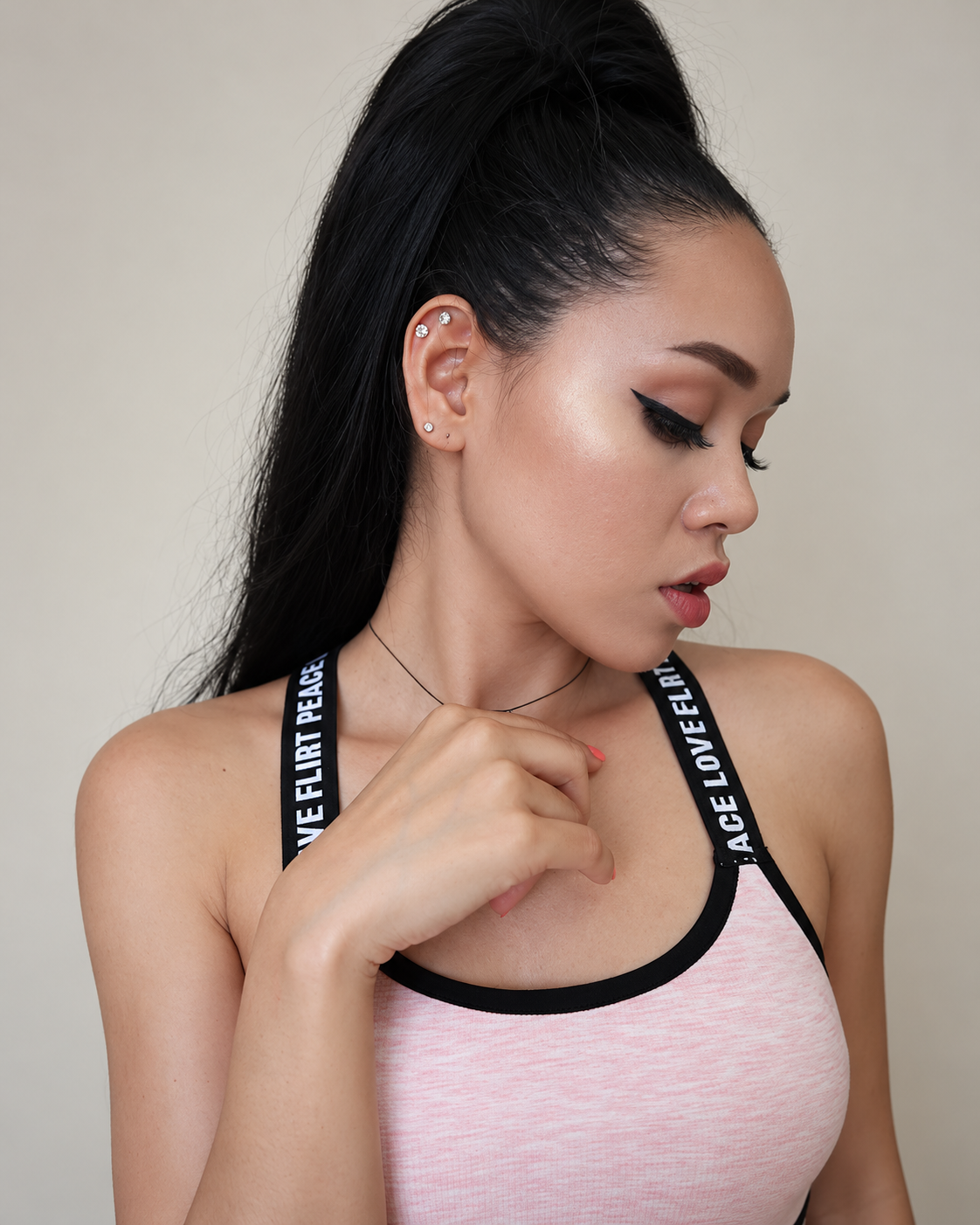
Rina Kozyreva — when a mother’s ritual becomes an artistic inheritance
Rina Kozyreva is a makeup artist based in Vladivostok, Russia, whose relationship with cosmetics began the way many of the deepest aesthetic educations do: through observation rather than instruction. She watched her mother prepare — the brushes arranged in their particular order, the pencil moved along the lid with a specific deliberateness, the red lipstick that was the signature and the conclusion of the ritual. These observations were not lessons. They were something closer to an initiation into the understanding that beauty has a grammar — that the objects on the dressing table are not simply products but a vocabulary, and that knowing how to arrange them into something meaningful is a skill that can be learned, practised, and eventually made one’s own.
“It was my mother who gave such a special love to cosmetics and the process,” Rina has said — adding, with a tenderness that carries considerable weight, that sometimes when she repeats the same movements she saw at that childhood dressing table, she half-expects to see her mother’s face in the mirror. This is the specific quality of makeup that distinguishes it from most other beauty practices: it is transmitted person to person, mother to daughter, artist to student, in a way that carries not only technique but meaning. The brush, the liner, the lipstick — these are objects, but they are also inheritances. The red lipstick that Rina’s mother wore is not the same object as any red lipstick Rina now works with professionally. But it is the origin of the entire practice. The most enduring beauty practices are those transmitted through sustained attention to someone whose relationship with beauty is already formed — and Rina’s professional artistry is inseparable from that formative childhood attention.


Russian makeup artistry — precision, theatricality, and the space between them
Russia occupies a specific and insufficiently examined position in the global landscape of professional makeup artistry. The country has produced a significant community of makeup artists, makeup educators, and beauty content creators whose work circulates widely through social media and professional networks — and whose approach to the craft is characterised by a particular combination of technical rigour and willingness to work at the extremes of the form. The everyday beauty aesthetic that the Russian cultural context has historically valued — precision, symmetry, polished execution, the elevation of ordinary appearance toward something more formally composed — sits in productive tension with the experimental tradition of fashion and theatrical makeup, in which the same rigorous technique is deployed in the service of transformation rather than enhancement.
This tension is not a contradiction. It is a resource. The makeup artist trained in a tradition that takes the technical demands of precision beauty seriously — where the symmetry of a liner, the blending of a shadow, the graduation of a contour are not satisfactory until they meet a high standard — is better equipped to work in fashion and editorial contexts than the artist whose training has been primarily in experimental work. The technical discipline provides the control that creative freedom requires: you cannot deliberately break the rules of facial proportion with authority until you know those rules well enough to have applied them correctly many times. The same principle that governs the most effective skincare — that understanding the biological system you are working within is the prerequisite for any effective intervention — governs professional makeup: understanding the visual system of the face is the prerequisite for any intervention, corrective or creative, that will produce a consistent and intentional result.
Fashion makeup refers to the category of professional makeup practice oriented toward editorial photography, runway presentation, and creative visual production rather than toward the enhancement of the individual client’s everyday appearance. The fundamental distinction from beauty makeup is in its relationship to the face: beauty makeup tends to work with the face’s existing qualities, using technique to enhance, refine, or correct toward a standard of beauty that the client and the market recognise as desirable. Fashion makeup can work against the face’s existing qualities — exaggerating proportion, introducing colour where none naturally exists, creating texture or graphic line that prioritises the visual impact of the image over the conventional attractiveness of the subject. This distinction has practical implications for the techniques used and the judgment exercised: fashion makeup artists must understand the visual language of proportion, colour, and texture well enough to manipulate it intentionally rather than simply applying it to optimise appearance. The professional competence required is therefore higher in certain respects than that required for everyday beauty work, because the artist cannot rely on conventional beauty standards as a guide to whether the result is correct — they must evaluate it against the more abstract standard of whether it produces the intended visual effect in the photographic or editorial context for which it is being created.


The rule before the break — why technical discipline is creative freedom
Rina Kozyreva’s approach to her craft contains a principle that is worth articulating explicitly because it is one of the most important available truths about creative work in any discipline: it is good to be afraid of breaking rules, until you understand them well enough that breaking them is a choice rather than an accident. The artist who violates the conventions of facial proportion inadvertently — who applies liner at the wrong angle for the eye shape in front of them, or blends shadow to a position that creates a proportional distortion they did not intend — is not being creative. They are making an error. The artist who understands exactly why conventional liner placement works the way it does, and who then chooses to apply it differently in order to achieve a specific visual effect that conventional placement cannot produce — that artist is exercising creative freedom. The distinction between the two is technical knowledge.
This is the specific value of formal makeup training in contexts — such as the Russian professional makeup education that Rina pursued — that take technical rigour seriously. The student who learns to match liner angles to eye shapes, to blend shadow to the correct depth for the desired effect, to build a complexion base that responds to the lighting conditions in which it will be seen, to understand colour theory well enough to predict how pigments will behave on different skin tones — that student is not being taught to reproduce a formula. They are being given the tools to make intentional decisions. Fashion makeup’s freedom is available most fully to the artist who has first mastered the discipline that makes freedom meaningful — because freedom without understanding is not expression, it is accident. Rina’s description of fashion makeup as the place where she finds freedom from the limits of everyday work — where the brush can move without confining itself to the conventional frame — is the description of an artist who has earned that freedom through the accumulation of technical knowledge. The most sophisticated approach to makeup always begins with the question of what the specific conditions require — the specific face, the specific light, the specific occasion — rather than with the application of a preferred formula regardless of context.
The relationship between makeup technique and creative freedom is one of enablement rather than constraint: technical mastery provides the artist with the understanding of how specific tools, products, and placements produce specific visual effects, which in turn allows them to produce those effects intentionally rather than accidentally, and to deviate from conventional practice with authority when the creative context requires it. Professional makeup training — particularly in contexts that take technical rigour seriously, such as the Russian professional makeup education tradition — teaches not what looks are currently fashionable but how makeup functions as a visual design system: the relationship between line direction and the perception of proportion, between shadow placement and the apparent depth of facial structure, between colour and the reading of skin tone. This systemic understanding is what allows the trained makeup artist to work across contexts — beauty, fashion, editorial, theatrical, film — with consistent results, and to adapt their approach to the specific requirements of each context rather than applying the same formula regardless of circumstance. The artist who has internalised these principles can choose to apply or violate them with equal precision — which is the condition under which creative work becomes genuinely expressive rather than merely technically competent or merely experimental.
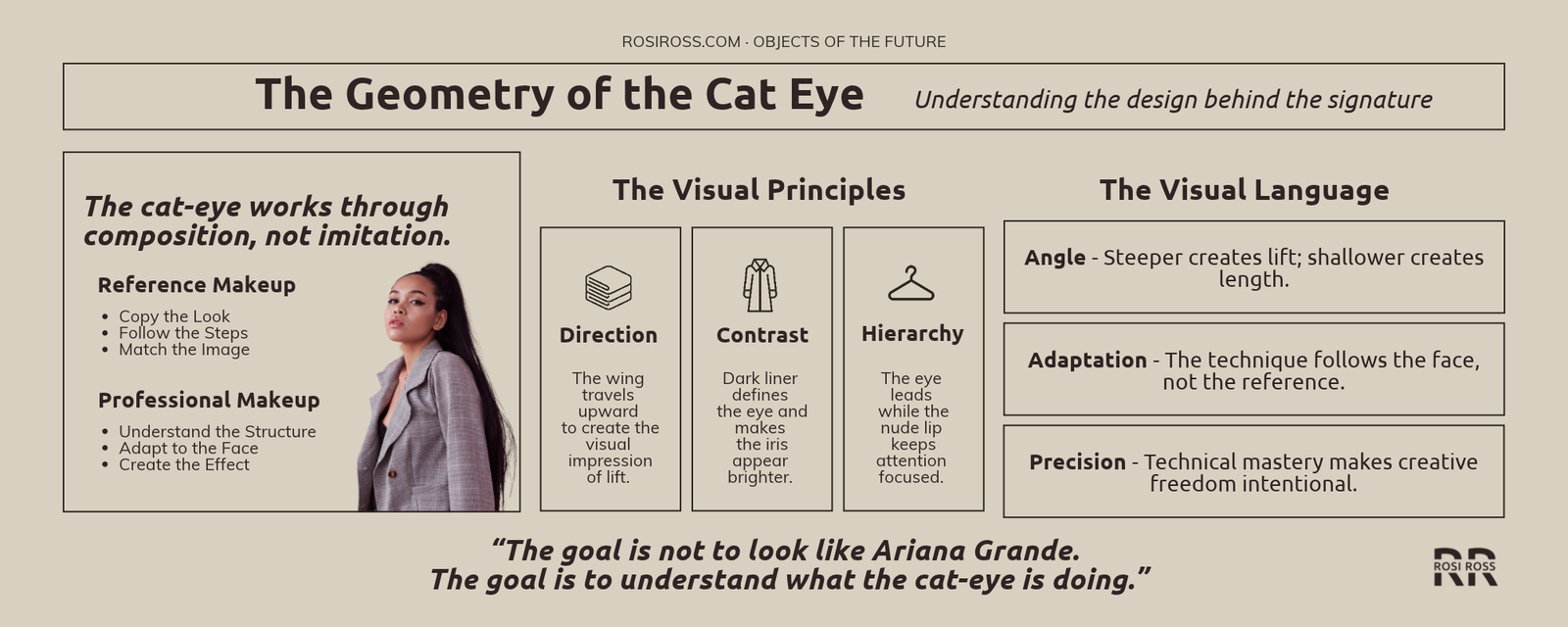
What the Ariana Grande look teaches — and what it cannot
Ariana Grande’s makeup signature is useful to the serious beauty student not because it is worth reproducing but because it is worth understanding. The cat-eye’s geometry, the nude lip’s compositional function, the luminous complexion’s role as ground rather than figure — these are principles, not instructions, and principles are more valuable than instructions because they survive the change of context that makes any specific instruction obsolete. An instruction tells you how to produce a particular result under a particular set of conditions. A principle tells you how to produce the right result under any set of conditions — including conditions that no instruction anticipated because no instruction was written with your specific face, your specific light, your specific occasion, or your specific intention in mind.
Rina Kozyreva’s story begins at a childhood dressing table in Vladivostok, with a red lipstick she was not yet old enough to wear, watching the movements that would eventually become her professional practice. It passes through a makeup school where knowledge was absorbed with the speed and thoroughness of someone who had been preparing for this education since childhood. It arrives at fashion makeup — the discipline in which all of that accumulated technical knowledge is placed in the service of an image rather than a face, where the question is not “how do I make this person look beautiful” but “what does this image need to communicate?” The answer to that second question requires everything the first question has taught — and more. It requires the ability to see the face in front of you not as a beauty problem to be solved but as a visual proposition to be developed. That ability is what serious makeup training produces. And it is what the most lasting beauty practice, whether personal or professional, is ultimately built on. The future of beauty expertise belongs to those who understand makeup as both a technical practice and a visual language — and who can move between those registers as the work requires.
“The goal is not to look like Ariana Grande.
The goal is to understand
what the cat-eye is doing —
why the wing travels upward,
why the lip stays quiet,
why the complexion serves
rather than competes.
Learn that,
and you have something
considerably more useful
than someone else’s look.
You have the principles
from which your own can be built.”

